
A leak at the dishwasher door is the door seal only about half the time. The other half traces back to a cracked spray arm, a float switch that’s stuck, a loose drain hose, or a stuck-open inlet valve, each with its own distinct symptom. Checking where and when the water shows up before replacing anything is what actually tells the two apart.
Key takeaways
- A puddle near the door doesn’t automatically mean the seal has failed. Four other common causes produce a similar-looking leak
- Where the water appears (corners, center, underneath) and when it appears (during the wash, during drain, even when idle) narrows the cause fast
- A real seal problem shows visible cracking, hardening, or a section pulled from its channel, not just a puddle
- Replacing the gasket first without checking is one of the most common reasons a leak doesn’t actually stop, based on real repair cases where the gasket was swapped and the leak continued anyway
- Appliance Gasket quotes one exact price after getting your dishwasher’s brand and model, with a $75–$95 diagnostic fee credited toward your repair, and offers same-day service across DC, Maryland, and Northern Virginia
- Call (202) 200-8501 for a model-based quote
Where the water shows up tells you more than you’d think
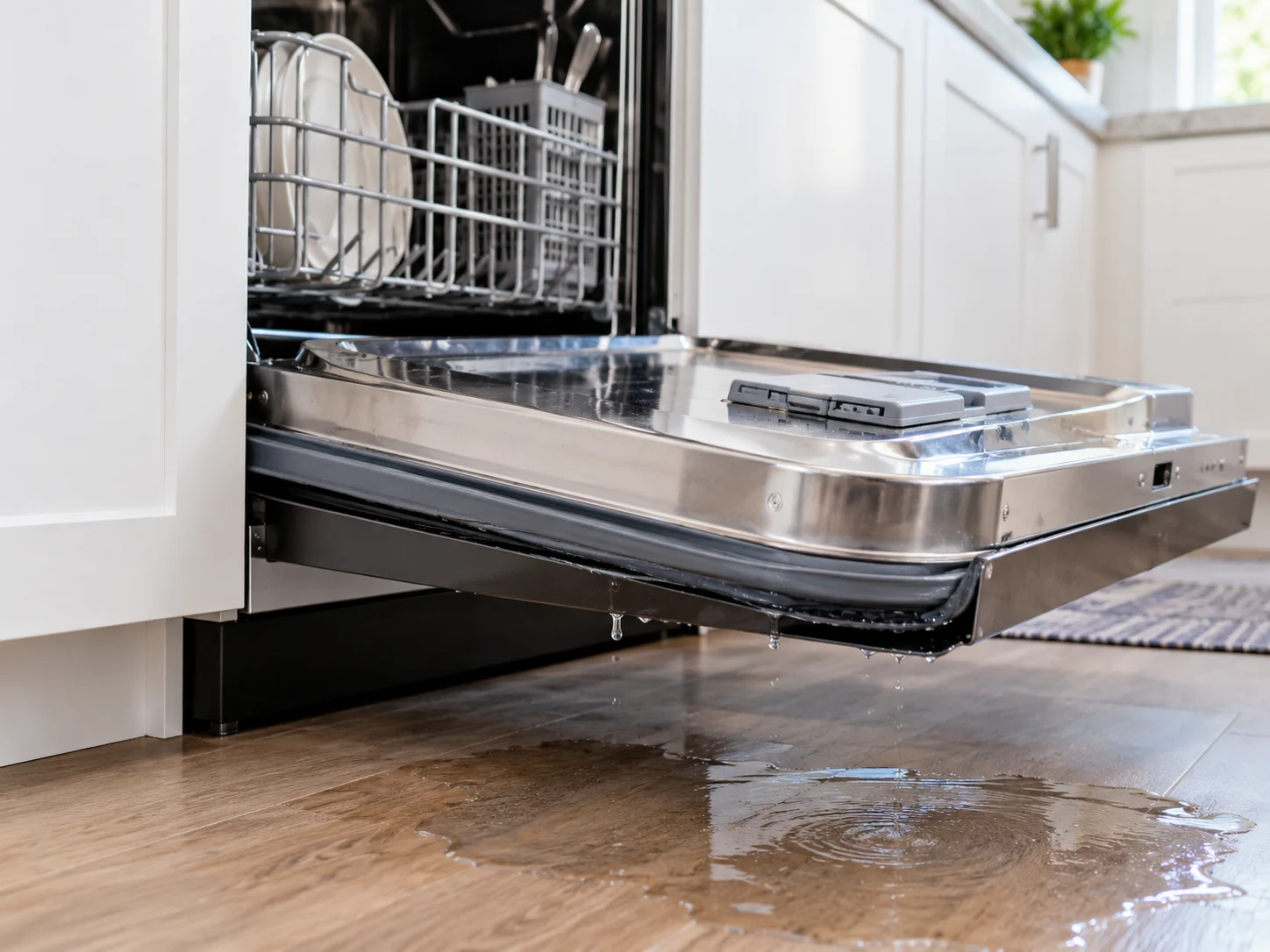
Water at the bottom corners of the door usually points to the seal. Water pooling under the whole unit usually points to a hose or the float switch. Water that only appears during the wash cycle, not during drain or while the dishwasher sits idle, usually points to the spray arm or the seal under direct water pressure.
| Where / when | Likely cause | Why |
| Bottom corners, during wash | Door seal | Water pressure against the seal is highest during the active wash |
| Pooling under the whole unit | Drain hose, float switch | Water escaping before it reaches the door or after it leaves the tub |
| Dishwasher overfilling, water visible above the heating element | Float switch, inlet valve | Water never should have reached that level in the first place |
| Only during the drain portion of the cycle | Drain hose or clamp | The leak is timed to water leaving, not entering |
This table is the fastest way to narrow things down before you touch anything. If your symptom lines up with more than one row, work through the sections below in order. They match the table and build on each other.
Check the door seal itself before assuming it’s the problem
Run a hand along the entire rubber gasket around the door frame, feeling for cracks, hardened or brittle sections, or a spot where the rubber has pulled away from its channel. A seal that feels uniformly soft and flexible everywhere you check is probably not the actual cause, even if there’s a puddle nearby.
This is the step most guides skip entirely. They’ll tell you a worn door seal causes leaks, list it as one cause among several, and move on without ever describing how to check it. Running your fingers slowly around the full perimeter, not just the parts you can see, catches the damage that visual inspection alone misses, since a lot of seal wear starts on the inner fold where it’s hardest to spot.
If the seal checks out clean everywhere, that’s useful information. It means the leak is coming from somewhere else, and the next three sections cover exactly where to look.
Signs it’s the spray arm, not the seal
A cracked spray arm, or one with a clogged jet, sprays water at an angle instead of straight up, which can throw water hard enough against the door to leak out even with a perfectly good seal underneath. This is one of the easiest causes to miss, because the symptom at the door looks identical to an actual seal failure.
Real repair cases documented on AppliancePartsPros’ own dishwasher gasket and seal page back this up directly. Customers describe replacing the door gasket, having the leak continue anyway, and later tracing the actual problem to a cracked spray arm spraying water off-angle. That pattern, replacing the seal first and still having a leak, is common enough that it’s worth checking the spray arm before you order a new gasket, not after.
Pull out the lower rack, spin the spray arm by hand, and look for cracks along its length or jets that are clogged with mineral buildup or food debris. A spray arm that spins freely and sprays evenly in every direction is doing its job. One that’s cracked, stuck, or spraying unevenly is a real candidate for the leak, seal condition aside.
Signs it’s the float switch or water inlet valve
If the dishwasher is overfilling, with water visible above the heating element when you open the door mid-cycle, a stuck float switch or a water inlet valve that won’t shut off is the likely cause, not the door seal. The water never should have reached that level in the first place, which means no amount of door-seal replacement fixes it.
The float switch is a small assembly, usually a plastic cap on the tub floor, that rises with the water level and tells the dishwasher when to stop filling. If it’s stuck down, either from debris underneath it or a mechanical failure, the machine keeps filling well past where it should stop, and that extra water has to go somewhere. A water inlet valve that’s failed open causes the exact same overfilling symptom from the other end of the system.
Open the door partway through the fill cycle and look at the water level against the heating element. If it’s noticeably higher than it should be, that’s your answer, and it has nothing to do with the seal around the door.
Signs it’s a drain hose or clamp, not the seal
A leak that shows up specifically during the drain portion of the cycle, or a puddle that’s centered under the unit rather than near the door, points to a loose clamp or a cracked drain hose rather than the door seal. Checking behind the kickplate for a wet hose or a loose clamp takes a couple of minutes and rules this out before anything else gets replaced.
This cause shows up more often than people expect in a lot of kitchens across Washington DC’s older rowhomes and the established suburbs of Maryland and Northern Virginia, where the dishwasher hookup is often original to whenever the kitchen was last renovated. A drain hose or clamp that’s simply old and brittle fails on its own timeline, regardless of how new or old the dishwasher itself is, which is why this cause can show up even on a dishwasher that’s only a few years old if it was installed onto older plumbing.
Pull the kickplate off the bottom of the unit, run a short cycle, and watch for water at the hose connections or along the hose itself. A dry hose and tight clamps rule this out quickly, which narrows things down to whichever of the earlier sections actually matches your symptom.
The checklist: seal or something else?
Replace the door seal when the rubber itself shows cracking, hardening, or has pulled from its channel, the leak happens specifically during the wash portion of the cycle, and the checks above all come back clean otherwise. Look elsewhere when the seal feels intact everywhere you checked, the leak happens during drain or while the dishwasher sits idle, the unit is overfilling, or there’s a wet hose or loose clamp behind the kickplate.
Replace the seal if:
- The rubber shows visible cracking, hardening, or has pulled away from its channel
- The leak happens during the active wash, not drain or idle
- The spray arm, float switch, inlet valve, and drain hose all check out fine
Look elsewhere if:
- The seal feels uniformly soft and flexible with no damage anywhere
- The leak happens during drain, or even when the dishwasher isn’t running
- The unit is overfilling above the heating element
- There’s a wet hose or a loose clamp behind the kickplate
This is the single most useful passage in this whole post, because it’s the one thing no competitor content actually states this specifically. Most guides list the same five or six causes side by side and leave you to guess which one applies. This checklist is built to remove that guesswork.
The bottom line
Check where and when the leak happens first, inspect the seal itself rather than assuming, then work through the spray arm, float switch and inlet valve, and drain hose in turn. If the checks don’t point clearly to one cause, or a seal replacement didn’t stop the leak, that’s the point to get a model-based diagnosis rather than keep guessing at parts. Appliance Gasket quotes one exact price after getting your dishwasher’s brand and model, with a $75–$95 diagnostic fee credited toward your repair, and offers same-day service across DC, Maryland, and Northern Virginia.
Get your dishwasher leak diagnosed in DC, MD & VA
If the checks above don’t give you a clear answer, or the leak keeps happening after a seal replacement, the next step is a model-based diagnosis rather than guessing at parts. Appliance Gasket’s dishwasher repair service already treats a puddle as a starting point, not a conclusion, checking the seal’s fit and condition alongside door alignment and hoses before anything gets replaced.
Send your dishwasher’s brand, model, and ZIP code and Appliance Gasket will quote one exact price with a $75–$95 diagnostic fee credited toward your repair, with same-day appointments available across Washington DC, Maryland, and Northern Virginia. If you’d rather talk through what you’re seeing before booking anything, reach out through our contact page and we’ll walk through it with you.
Appliance Gasket
Phone: (202) 200-8501
Email: Ilhamfraidoon@gmail.com
Address: Fairfax City, VA 22031
Serving Washington DC, Maryland & Northern Virginia
Frequently asked questions
Q1: Is it safe to keep running a dishwasher that’s leaking?
Running it a few more times while you diagnose the cause is generally fine, as long as you’re watching for water reaching anything electrical or pooling long enough to damage flooring or cabinets. Letting a small leak continue for weeks without checking it is what turns a simple seal or hose fix into a bigger repair, since standing water under the unit can eventually affect the floor or the cabinet base it sits against.
Q2: Why does my dishwasher only leak sometimes, not every cycle?
An intermittent leak usually means the cause is load-dependent or position-dependent rather than a constant failure, like a spray arm that only hits the door at a certain angle with a full rack, or a seal that only gaps open when the door isn’t latched perfectly square. Pay attention to what’s different about the cycles that leak versus the ones that don’t, a fuller load, a particular rack position, which narrows the cause faster than waiting for it to happen every time.
Q3: I already replaced the door gasket and it’s still leaking. What now?
Check the spray arm next. This is a documented pattern in real repair cases: the gasket gets replaced first because it’s the most commonly assumed cause, the leak continues, and the actual problem turns out to be a cracked or clogged spray arm throwing water at the wrong angle. Pull the lower rack and inspect the spray arm directly rather than assuming the new gasket is defective.
Q4: Can too much detergent or the wrong detergent cause a door leak?
Yes, though indirectly. Excess suds from using regular dish soap instead of dishwasher detergent, or simply using too much, can force foam and water past the seal during the wash, which looks exactly like a seal failure even when the gasket itself is fine. Switching to the correct amount of dishwasher-specific detergent and running one cycle to see if the leak stops is a quick way to rule this out.
Q5: Does an unlevel dishwasher cause leaking even with a good seal?
Yes. A dishwasher that isn’t sitting level can cause water to pool unevenly against one side of the door or tub, which puts pressure on a section of the seal that was never designed to hold back standing water, even if the gasket itself is in good condition. Checking the unit with a level, front to back and side to side, and adjusting the feet if needed, is worth doing before assuming the seal has failed.
Q6: How much does it cost to replace a dishwasher door seal versus a spray arm or valve?
The parts and labor cost varies by brand and model, and a seal, a spray arm, and an inlet valve are priced differently from each other even on the same dishwasher. Rather than guess at a number, sending your dishwasher’s brand and model gets you one exact, model-specific quote instead of a generic range that may not match what your unit actually needs.