
Refrigerator door gaskets typically last 5-10 years with normal residential use, though premium brands like Bosch and Sub-Zero can reach 15 years. Heavy usage, poor maintenance, or harsh environments (garages, extreme temperatures) can reduce lifespan to 3-5 years. According to energy efficiency studies, a failing gasket can increase energy usage by 15-30%. This guide covers brand-specific lifespans, warning signs, and when to replace.
Key Takeaways
- Average refrigerator gasket lifespan is 5-10 years with normal residential use
- Premium brands (Bosch, Sub-Zero) last 10-15 years, budget brands 5-7 years
- Failed dollar bill test, condensation, and higher energy bills signal replacement needed
- DIY replacement costs 20-150, professional service 130-300
- Regular cleaning and inspection every 6 months extends gasket life significantly
- Same-day gasket replacement available in Fairfax, VA and surrounding areas
Quick Answer: How Long Do Refrigerator Door Gaskets Last?
Average lifespan: 5-10 years for most residential refrigerators with normal use. Premium brands can last 12-15 years, while heavy use or harsh environments may require replacement in 3-5 years.
Start monitoring at year 5 with regular inspections. Replace immediately if dollar bill test fails AND visible damage exists. Average household opens fridge 20-25 times daily, accelerating wear.
Lifespan by usage type:
| Usage Type | Average Lifespan |
| Residential (2-4 people) | 8-10 years |
| Large family (5+ people) | 5-7 years |
| Commercial (restaurant) | 2-4 years |
| Garage/porch location | 3-5 years |
| Second refrigerator | 10-15 years |
Refrigerator Gasket Lifespan by Brand
Gasket life varies with seal design and material quality. The ranges below are general guidance, not manufacturer specifications:
Samsung: 7-10 years – Magnetic strip quality good, common issues with weakening after year 7.
LG: 6-9 years – Average magnetic strip quality, separation issues common.
Whirlpool: 8-12 years – Excellent compression seals, minimal issues.
GE: 7-10 years – Good quality across models, average durability.
Frigidaire: 6-8 years – Budget-friendly materials wear faster.
Kenmore: 8-12 years – OEM parts, longer lasting with proper maintenance.
Bosch: 10-15 years – Premium materials, rare issues.
Sub-Zero: 12-15 years – Commercial-grade seals, very rare failures.
7 Warning Signs Your Gasket Needs Replacement
1. Failed dollar bill test – Place dollar bill between door and cabinet, close firmly, try to pull out. If it slides out easily without resistance, seal is compromised. This simple test is recommended by Energy Star guidelines for checking refrigerator efficiency.
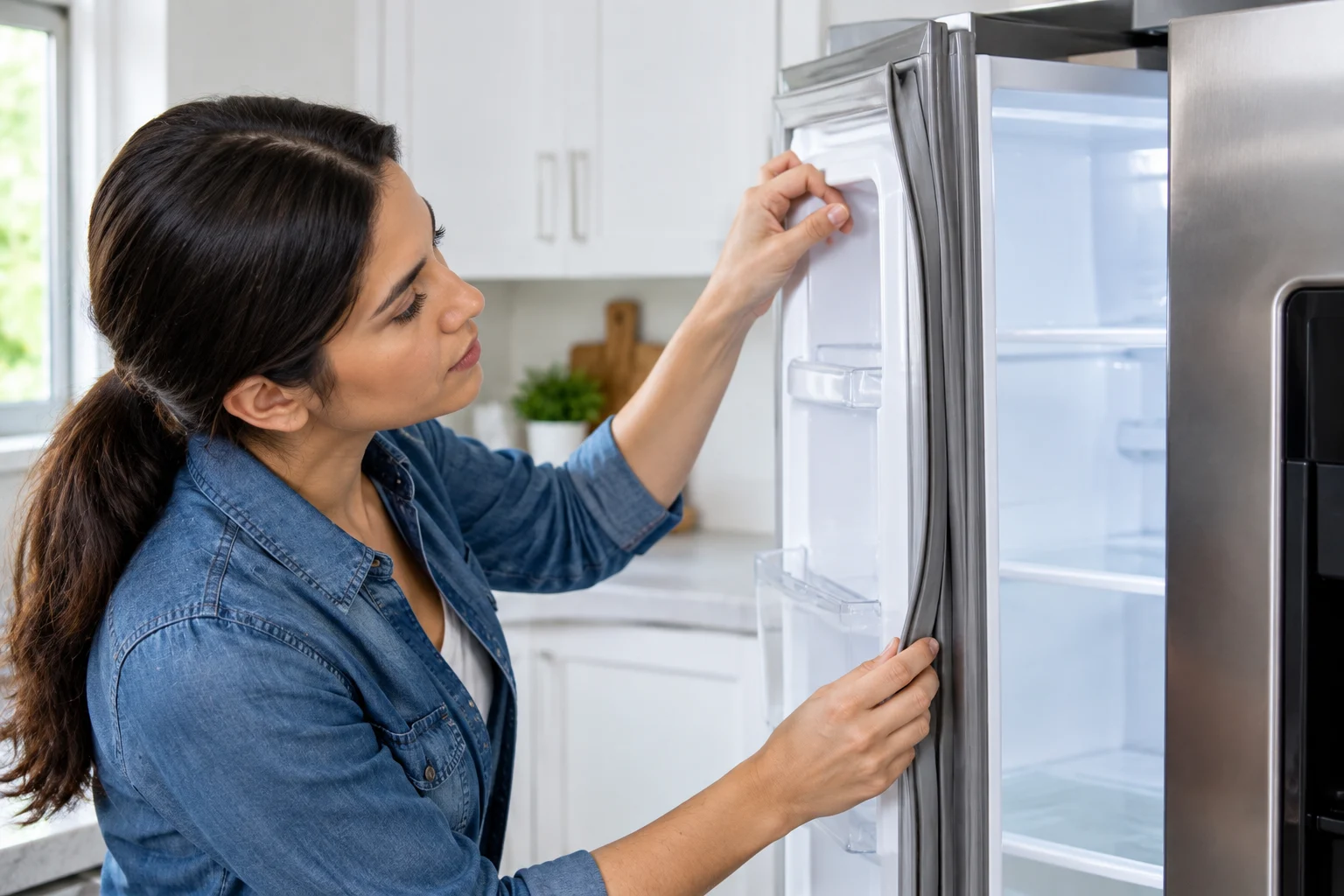
2. Visible cracks or tears – Inspect entire gasket perimeter for cracks, tears, warping, or hardening. Any visible damage means replacement needed soon.
3. Condensation and frost buildup – Water droplets around door frame, condensation on exterior, excessive frost in freezer indicate warm air entering through failing gasket.
4. Higher energy bills – Sudden 15-30% spike in electricity without usage changes. Compressor runs constantly to maintain temperature. According to Energy Star data, refrigerators account for 8% of home energy use.
5. Food spoiling faster – Milk and vegetables spoiling faster, food freezing in refrigerator section, temperature fluctuations when checked with thermometer.
6. Door doesn’t close properly – Door bounces back after closing, drifts ajar on its own, or doesn’t align with cabinet.
7. Age over 7 years with symptoms – Gasket is 7+ years old with any combination of above symptoms. Proactive replacement prevents bigger problems.
What Happens If You Ignore a Bad Gasket?
Ignoring a failing gasket leads to cascading problems:
Energy bills increase 15-30% monthly – Average increase 15-40/month. Over 2 years: 360-960 in wasted energy, 2-6x the cost of timely replacement. The Department of Energy estimates refrigerators use 400-800 kWh annually.
Compressor works overtime – Reduces compressor lifespan by 2-3 years. Compressor replacement costs 500-800.
Food spoilage and waste – Average 100-200/month in wasted food. Over 1 year: 1,200-2,400, far exceeding gasket replacement cost.
Ice buildup in freezer – Warm air entering creates excess moisture, freezes on evaporator coils. Severe buildup can crack coils, requiring 300-600 repair.
Cost comparison: $150 gasket now vs $800+ compressor later. Total potential loss from ignoring bad gasket: 2,000-4,000+ over 2 years.
How to Test Your Refrigerator Gasket
Dollar Bill Test (Gold Standard):
- Place dollar bill between door and cabinet
- Close door firmly
- Try to pull bill out slowly
- Note resistance level
- Repeat every 6-8 inches around door
Good seal: Bill held firmly with consistent resistance
Bad seal: Bill slides out easily
Uneven seal: Firm in some areas, loose in others
Visual Inspection: Check for visible cracks, tears, mold, or hardening. Pull back gasket folds gently to check for debris. Test flexibility by pressing with finger.
Air Leak Test: Turn on fridge light, close door in dark room, look for light escaping around edges. Light visible means seal compromised.
When to test: Every 6 months starting year 5, every 3 months for garage refrigerators. For more maintenance tips, see our guide on refrigerator maintenance best practices.
Factors That Affect Gasket Lifespan
Material quality – Premium brands (Bosch, Sub-Zero) use higher-grade materials lasting 12-15 years. Budget brands use standard compounds lasting 6-8 years.
Usage frequency – Light use (5-10 openings/day): 10-15 years. Normal use (20-30/day): 8-10 years. Heavy use (40-60/day): 5-7 years.
Cleaning routine – Monthly cleaning extends lifespan by 2-3 years. Never cleaning reduces lifespan by 30-40%. Use mild soap and water, avoid harsh chemicals.
Environmental conditions – Indoor climate-controlled: full lifespan. Garage/porch (20°F-100°F+): reduces life 30-40%. High humidity promotes mold, reduces life 15-25%.
Door alignment – Properly aligned door ensures even wear. Misaligned door reduces life 15-25%. Check hinges quarterly.
Chemical exposure – Mild soap safe. Bleach damages rubber, reduces life 20-30%. Ammonia-based cleaners break down rubber, reduces life 25-35%.
Refrigerator Gasket Replacement Cost Guide
DIY parts cost: 20-150
- Universal/aftermarket: 20-60 (3-5 year lifespan)
- OEM mid-range (Samsung, LG, GE): 60-100 (7-10 year lifespan)
- OEM premium (Bosch, Sub-Zero): 100-200 (10-15 year lifespan)
Professional cost: 130-300
- Parts: 50-150
- Labor: 80-180 (30-45 minutes)
- Warranty: 30-90 days on parts and labor
Energy savings from new gasket: 50-150 per year (15-30% reduction). New gasket pays for itself in energy savings alone over 10 years.
When replacement worth it vs new fridge: Replace gasket if fridge under 10 years old and otherwise working well. Consider new fridge if 12+ years old with multiple issues or repair costs exceed $500. For more on appliance repair costs, check our comprehensive guide.
DIY vs Professional Replacement
DIY pros: Save 80-180, learn skill, flexible timing, satisfaction
DIY cons: Risk of wrong part, improper install, no warranty, 1-2 hours time investment
Professional pros: Correct parts guaranteed, proper installation, 30-90 day warranty, 30-45 minutes time savings, additional inspection
Professional cons: Higher cost, scheduling required
When to call pro: Built-in or French door refrigerators, not comfortable with tools, need same-day service, want warranty on work
When DIY makes sense: Standard top/bottom fridge, handy with tools, have 2-3 hours available, budget tight
Average DIY time: 1-2 hours for first-timers
Average professional time: 30-45 minutes
How to Extend Your Gasket’s Lifespan
Monthly cleaning (5 minutes): Mix mild dish soap with warm water. Wipe entire gasket including folds. Use soft toothbrush for stubborn spots. Dry thoroughly to prevent mold.
Avoid harsh chemicals: Use mild soap, vinegar solution (1:1), or baking soda paste. Avoid bleach, ammonia, abrasive scrubbers that damage rubber.
Proper door closure: Close door gently, don’t slam. Check door closes fully every time. Don’t overpack shelves. Teach children proper closure.
Regular inspection: Year 1-4: annually. Year 5-7: every 6 months. Year 8+: every 3 months. Dollar bill test, visual check, door alignment.
Lubrication: Apply thin layer of petroleum jelly every 6 months to prevent drying and cracking. Wipe off excess. Don’t use cooking oil or WD-40.
Door alignment checks: Quarterly check hinges and alignment. Most refrigerators have adjustable hinges. Small adjustments make big difference.
Brand-Specific Maintenance Tips
Samsung: Clean folds gently with soft toothbrush. Check magnetic strip strength annually after year 7. Avoid harsh cleaners.
LG: Inspect magnetic strip attachment quarterly after year 7. Don’t pull on gasket when cleaning. Lubricate folds every 6 months.
Whirlpool: Check hinge alignment quarterly (most important). Compression seals benefit from petroleum jelly. Generally low-maintenance.
GE: Clean thoroughly in humid climates to prevent mold. Use vinegar solution monthly if mold-prone. Check magnetic strip annually.
Bosch/Sub-Zero: Standard monthly cleaning sufficient. Annual inspection starting year 10. Rarely need lubrication (premium materials).
When Gasket Replacement Isn’t Enough
Compressor problems: If fridge still runs constantly after gasket replacement, compressor may be damaged. Compressor replacement: 500-800. Often more economical to replace entire refrigerator.
Thermostat issues: Temperature still inconsistent after gasket replacement may indicate faulty thermostat. Thermostat replacement: 100-200.
Door alignment problems: New gasket still doesn’t seal properly may need hinge adjustment. Professional alignment: 80-150.
When to replace entire refrigerator: Age 10+ years with multiple issues, repair costs exceed 50% of new fridge cost (800-3,000+), frequent breakdowns despite repairs. For guidance on when to repair vs replace appliances, see our decision guide.
Decision matrix: Under 8 years with good condition and repair under $300 = repair. Over 12 years with multiple failures = replace
Conclusion
Refrigerator door gaskets typically last 5-10 years with proper care. Premium brands like Bosch and Sub-Zero can reach 15 years, while heavy use or harsh environments may require replacement in 3-5 years. Regular inspection every 6 months, proper cleaning, and prompt replacement when warning signs appear will keep your refrigerator running efficiently.
Ignoring a bad gasket can lead to 15-30% higher energy bills, food spoilage, and eventual compressor failure costing $500-800. A $150 gasket replacement today can save you hundreds in the long run.
For homeowners in Fairfax City, VA and surrounding areas, professional gasket replacement is available with same-day service, model-matched parts, and warranty coverage. Don’t wait until your gasket fails completely—inspect today and replace if needed.
.
Contact Appliance Gasket for Same-Day Service
If your refrigerator gasket is failing and you need fast, reliable replacement in the DMV area, Appliance Gasket provides same-day service with model-matched parts and professional installation.
Service Coverage:
- Fairfax City, VA 22031 (base location)
- Northern Virginia: Falls Church, Arlington, Alexandria, Springfield, McLean, Reston, Herndon
- Washington DC: All neighborhoods including Georgetown, Capitol Hill, Navy Yard, The Wharf
- Maryland suburbs: Bethesda, Silver Spring, Rockville, Potomac, Gaithersburg
- Total: 50+ neighborhoods across DMV
What You Get:
- $75–$95 diagnostic inspection (credited toward your repair) and flat-rate quote by text within 1 hour
- Model-matched gaskets in stock for all major brands
- Same-day or next-day appointments (Mon-Sat, 8am-6pm)
- 30-90 day warranty on parts and labor
- Gasket specialists with 4 years experience
- 1,200+ homeowners served across DMV
- Average response time: 45 minutes during business hours
- DIY gaskets available matched to your model
- Commercial service for restaurants, cafés, laundromats
Appliance Gasket
Fairfax City, VA 22031
Phone: (202) 200-8501
Email: Ilhamfraidoon@gmail.com
Call now for a free quote or to book same-day service. Most appointments available within 24 hours. Text a photo of your model tag to (202) 200-8501 for instant pricing.
FAQ
Q1: Can you repair a gasket or must it be replaced?
Minor issues like dirt or misalignment can be fixed with cleaning and adjustment. However, cracked, torn, or hardened gaskets must be replaced. Cleaning helps temporarily, but damaged rubber cannot be repaired.
Q2: How often should you clean refrigerator gaskets?
Clean monthly with mild soap and water. Deep clean every 3 months with vinegar solution. Inspect every 6 months starting year 5, or every 3 months for garage refrigerators.
Q3: What causes gaskets to fail prematurely?
Harsh cleaning chemicals (bleach, ammonia) break down rubber reducing lifespan 20-30%. Extreme temperatures (garage locations) reduce life 30-40%. Frequent door slamming, poor alignment, and lack of cleaning also accelerate failure.
Q4: Will a new gasket fix high energy bills?
If high bills are caused by a failing gasket, yes. A new gasket can reduce energy usage by 15-30%, saving 50-150 annually. However, old compressors or poor insulation won’t improve with gasket replacement alone.
Q5: Is it worth replacing a gasket on an old refrigerator?
If the fridge is under 10 years old and otherwise working well, yes. Gasket replacement (130-300) costs far less than a new refrigerator (800-3,000+). Replace the entire appliance if it’s 12+ years old with multiple issues.
Q6: How do I find the right gasket for my model?
Locate the model number inside the door, on the side wall, or behind crisper drawers. Search online with exact model number or call a parts supplier. Professional technicians will source the correct part for you.
Q7: What’s the difference between cheap and expensive gaskets?
OEM gaskets cost more (60-150) but fit perfectly, use higher-quality materials lasting 8-12 years, and come with 1-2 year warranties. Universal gaskets are cheaper (20-60) but may not seal as well and last only 3-5 years.
Q8: Can I use my refrigerator with a bad gasket?
Temporarily yes, but expect 15-30% higher energy bills, potential food spoilage, and increased wear on the compressor. Replace as soon as possible to avoid further damage. A $150 gasket replacement today prevents $800+ compressor replacement tomorrow.