
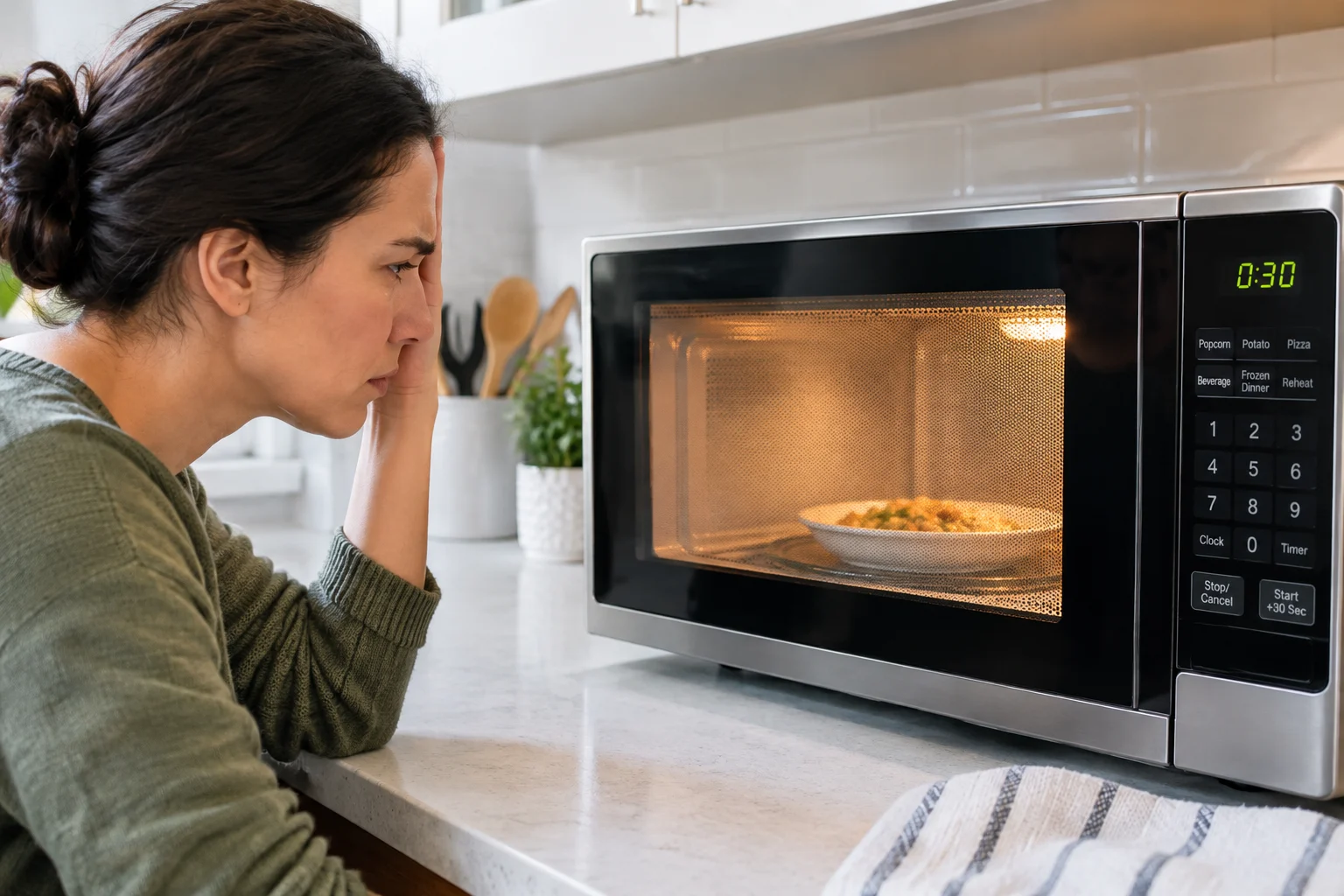
A microwave that runs but won’t heat almost always comes down to one of four things: a failed magnetron, a stuck door safety switch, a blown high-voltage fuse, or a bad high-voltage diode or capacitor. The turntable, light, and timer can keep working normally even after the heating function has completely failed, since they run on a separate circuit. Whether it’s worth fixing depends mainly on the microwave’s type, its age, and which part actually failed.
Key takeaways
- Magnetron failure and a faulty door switch are the two most common reasons a microwave runs but won’t heat
- The turntable, light, and timer can all work normally even when the heating function has failed completely, since they run on a separate circuit from the magnetron
- Opening the microwave’s internal casing yourself is dangerous. The high-voltage capacitor can hold a lethal charge even after the unit has been unplugged
- Countertop microwaves are usually cheaper to replace than repair. Built-in and over-the-range models are often worth repairing if the unit is still relatively young
- A few quick, safe checks (door latch, power source, delay or demo settings) rule out the simplest causes before you assume a part has failed
- Appliance Gasket quotes one exact price after getting your appliance’s brand and model, with a $75–$95 diagnostic fee credited toward your repair, and offers same-day service across DC, Maryland, and Northern Virginia
- Call (202) 200-8501 for a model-based quote
Most common causes when a microwave runs but won’t heat
Four parts cause almost every case of a microwave running without heating: a failed magnetron, a stuck door safety switch, a blown high-voltage fuse, or a bad high-voltage diode or capacitor. Each one fails for a different reason, but all four sit inside the same high-voltage section of the microwave, which is also why none of them are safe to test or replace yourself.
The magnetron is the component that actually generates the microwaves that heat your food, and it tends to fail from age or from the unit being run empty too many times. The door switch is a safety interlock, usually one of three or four inside the door frame, and it can fail mechanically from years of the door opening and closing. The high-voltage fuse is a protective part that blows when something else in the circuit draws too much current, often as a symptom of a failing magnetron rather than the root cause itself. The high-voltage diode works alongside the capacitor to boost the voltage reaching the magnetron, and when it fails, heating usually stops output entirely rather than just weakening it.
According to Sears Home Services’ breakdown of microwave repair calls, the thermostat accounts for about 53% of no-heat cases, the electronic control board for about 23%, a bad switch for about 15%, and other causes for the remaining 9%. That split lines up with what shows up most often in the field: a handful of parts cause the overwhelming majority of “runs but won’t heat” complaints, which is why the next few sections walk through the two most common ones in detail.
Is the magnetron failing? The warning signs to watch for
A failing magnetron shows up as food that stays cold or barely warm despite the microwave running its full cycle, a burning or electrical smell, or a loud humming or buzzing sound that wasn’t there before. Sometimes a magnetron fails gradually, so you might notice food heating less and less evenly over a few weeks before it stops heating entirely.
The magnetron is the single most expensive part in a microwave to replace, and on a standard countertop unit, the part and labor together often cost close enough to a new microwave that replacing the appliance makes more financial sense. That math changes on a built-in or over-the-range model, where a matching replacement unit costs more and takes longer to source and install, so repairing a failed magnetron in that case is frequently worth it if the rest of the unit is in good shape.
One detail that trips people up: a magnetron failure doesn’t always happen all at once. If your microwave has been heating inconsistently, running longer than usual for the same result, or making a new noise before this happened, that’s consistent with a magnetron on its way out rather than a sudden one-time failure.
Can a faulty door switch make the microwave run without heating?
Yes. Most microwaves use three or four safety interlock switches built into the door frame, and when one of them gets stuck or wears out, it can cut power specifically to the heating circuit while leaving everything else, the turntable, the light, the timer, running exactly as normal. This is one of the most common reasons a microwave seems to “run but do nothing,” because nothing about the outside behavior gives away which part actually failed.
These switches exist for a real safety reason: they make sure the microwave can’t generate radiation with the door open. Over years of daily use, the mechanical switch contacts wear out or the plastic actuator that trips them can crack, especially on a microwave that gets opened and closed dozens of times a day in a busy kitchen. A door that doesn’t latch with a firm, single click, or one that needs to be pushed or slammed to close, is often a sign that the switch mechanism, not just the seal, is already under stress.
The good news is that a door switch is usually one of the least expensive high-voltage-adjacent parts to diagnose and replace, especially compared to a magnetron. The bad news is that it still requires opening the unit to access, which is why this is a technician job rather than a weekend project, a point the next two sections cover in more detail.
Why it still spins, lights up, and sounds normal, but produces no heat
The turntable motor, interior light, and control timer all run on a separate, low-voltage circuit from the magnetron and the high-voltage parts that power it. That separation is exactly why a microwave can run through a full cycle, complete with the usual sounds, the turntable spinning, and the display counting down, while producing zero heat: the failure is isolated to one side of the unit’s wiring, and the other side has no idea anything is wrong.
This is also why “it sounds fine” is one of the most misleading signals when something’s actually broken. People often assume a microwave that still hums, spins, and lights up must have a minor problem, when in reality the magnetron, the door switch, the fuse, or the diode can fail completely while every other system keeps operating exactly as designed. If your microwave finishes its countdown and the food is cold, that’s a heating-circuit problem, not a sign the whole unit is failing.
Quick checks to run before calling a repair technician
Before assuming a part has failed, a few checks rule out the simplest and safest-to-fix causes. Confirm the door is closing and latching fully, with no visible crack or warping in the door frame, since a door that won’t seal flush can sometimes be read by the switches as open. Check whether a delayed start, demo mode, or control lock has accidentally been turned on, since all three can make a microwave run its full cycle without actually heating. Make sure the power level hasn’t been set unusually low, and plug the unit directly into a wall outlet rather than an extension cord or power strip, since a weak power supply can cause heating to drop off even when every part inside is fine.
These four checks take a couple of minutes and catch a real share of “no heat” complaints that have nothing to do with a failed part at all. If you’ve run through all of them and the microwave still isn’t heating, that points to one of the internal parts covered above, and that’s where DIY troubleshooting needs to stop.
Is it safe to repair a microwave yourself?
No, not past the checks above. The high-voltage capacitor inside a microwave can hold a lethal electrical charge even after the unit has been unplugged, sometimes for hours or longer, which is why magnetron, capacitor, diode, and fuse repairs should always go to a trained technician rather than being attempted at home.
This isn’t a generic safety disclaimer. A microwave’s capacitor is built to store a large charge specifically so the magnetron can draw the power it needs in short bursts, and that stored charge doesn’t automatically drain away when you unplug the cord. Technicians use a specific discharge procedure before touching anything inside the high-voltage section, and skipping that step is where serious injuries happen. If a repair requires opening the back or sides of the microwave to reach the magnetron, capacitor, diode, or fuse, that’s the line between a safe DIY check and a job for a professional.
Repair or replace: the actual math
Countertop microwaves are usually cheaper to replace than repair once a major part like the magnetron fails, while built-in and over-the-range models are often worth repairing if the unit is still roughly 7 to 8 years old or younger, since a matching replacement costs more and takes longer to source and install. The type of microwave you have, combined with its age and which specific part failed, decides the answer more reliably than any flat rule of thumb.
Here’s how that plays out in practice. A countertop microwave with a failed magnetron rarely makes sense to repair, because the part and labor together often approach what a comparable new unit costs, and a new countertop microwave can usually be swapped in within minutes. According to Fixr’s microwave repair cost data, simpler fixes like a door switch or fuse tend to sit well below that threshold, which is why those repairs are worth doing almost regardless of the microwave’s type. A built-in or over-the-range unit changes the calculation because replacement means a new cutout, matching dimensions, and a more involved installation, so repairing a magnetron or control board on one of these is frequently the more practical choice if the unit hasn’t already had other problems.
Age matters because a microwave nearing the end of its typical service life is more likely to have a second part fail soon after the first one is fixed, which makes repair money spent on borrowed time. A microwave that’s 2 or 3 years old with a single failed part is a very different decision than one that’s already 10 years old. The honest version of this math is that there’s no single answer that applies to every case, which is exactly why getting the actual model and the specific failed part diagnosed is worth more than guessing from a general rule.
How to prevent this heating failure from happening again
Three habits meaningfully cut the odds of a repeat failure: never run the microwave empty, keep the vents clear of grease and dust buildup so the unit doesn’t run hot, and avoid slamming or forcing the door shut. Running a microwave with nothing inside it means the magnetron has nowhere to send its energy except back into itself, which accelerates the exact kind of wear that leads to failure.
Blocked vents force the microwave’s internal components, including the magnetron, to run hotter than they’re designed for, and sustained heat is one of the quieter ways these parts age faster than they should. A quick wipe-down of the vent grilles every few weeks keeps airflow where it needs to be. As for the door, forcing it shut instead of checking what’s actually stopping it from closing, often a dish set too close to the front or something caught in the door track, puts repeated stress directly on the same switch mechanism covered earlier in this article, which is one of the more avoidable ways that part wears out early.
The bottom line
Most cases of a microwave running but not heating trace back to one of two parts: a failed magnetron or a stuck door switch, and the fact that everything else still works normally is exactly what makes those two causes easy to misread. Past the basic checks covered above, this isn’t a safe DIY repair, and whether it’s worth fixing comes down to the microwave’s type, its age, and which part actually failed rather than a one-size-fits-all rule. Appliance Gasket quotes one exact price after getting your appliance’s brand and model, with a $75–$95 diagnostic fee credited toward your repair, and offers same-day service across DC, Maryland, and Northern Virginia.
Get your microwave diagnosed in DC, MD & VA
If the quick checks above don’t solve it, the safest next step is a technician diagnosis rather than guessing at which part failed. Send your microwave’s brand, model, and ZIP code and Appliance Gasket will quote one exact price with a $75–$95 diagnostic fee credited toward your repair, with same-day appointments available across Washington DC, Maryland, and Northern Virginia. Reach out through our contact page to get started.
Appliance Gasket
Phone: (202) 200-8501
Email: Ilhamfraidoon@gmail.com
Address: Fairfax City, VA 22031
Serving Washington DC, Maryland & Northern Virginia
Frequently asked questions
Q1: How much does it typically cost to repair a microwave that won’t heat?
Cost depends heavily on which part failed and whether the microwave is a countertop or built-in model. Simpler repairs like a door switch or blown fuse tend to cost far less than a magnetron replacement, and built-in units generally run higher than countertop ones because of the added labor to access the part. Getting your specific model diagnosed gives a far more accurate number than any general estimate.
Q2: Can a blown fuse let the microwave run without heating instead of shutting it off completely?
Yes. The high-voltage fuse specifically protects the magnetron circuit, so when it blows, the microwave’s low-voltage systems, the turntable, light, and timer, keep running normally while only the heating function stops. A blown fuse is often a symptom of a bigger problem elsewhere in the high-voltage section rather than the root cause on its own, which is why a technician checks what caused it to blow in the first place.
Q3: Does running a microwave empty cause this kind of damage?
Yes, running a microwave with nothing inside it is one of the more common ways a magnetron wears out early. With no food or liquid to absorb the microwave energy, that energy reflects back into the magnetron itself, and repeated empty runs add up to real wear over time, even though a single accidental empty run usually won’t cause immediate failure.
Q4: Can a power surge cause a microwave to stop heating?
Yes, a sudden power surge, whether from a storm, a grid fluctuation, or another appliance on the same circuit, can damage the high-voltage diode or capacitor without affecting the microwave’s other functions. This is part of why a microwave that heated fine yesterday can suddenly stop today with no gradual warning signs beforehand.
Q5: How long does a microwave repair usually take once a technician arrives?
Most single-part repairs, like a door switch, fuse, or diode, take under an hour once the technician has confirmed the diagnosis and has the correct part on hand. A magnetron replacement can take a bit longer since it involves more disassembly, but the appointment itself is still typically a same-visit job rather than something that requires leaving the unit behind.
Q6: Should a built-in microwave be installed by a professional instead of doing it myself?
Yes, a built-in or over-the-range microwave involves electrical connections, exact cutout dimensions, and often venting that need to match the specific replacement model, which makes professional installation the safer and more reliable choice. A countertop microwave is a simple plug-in swap, but a built-in replacement installed incorrectly can create both a safety issue and a warranty problem.