

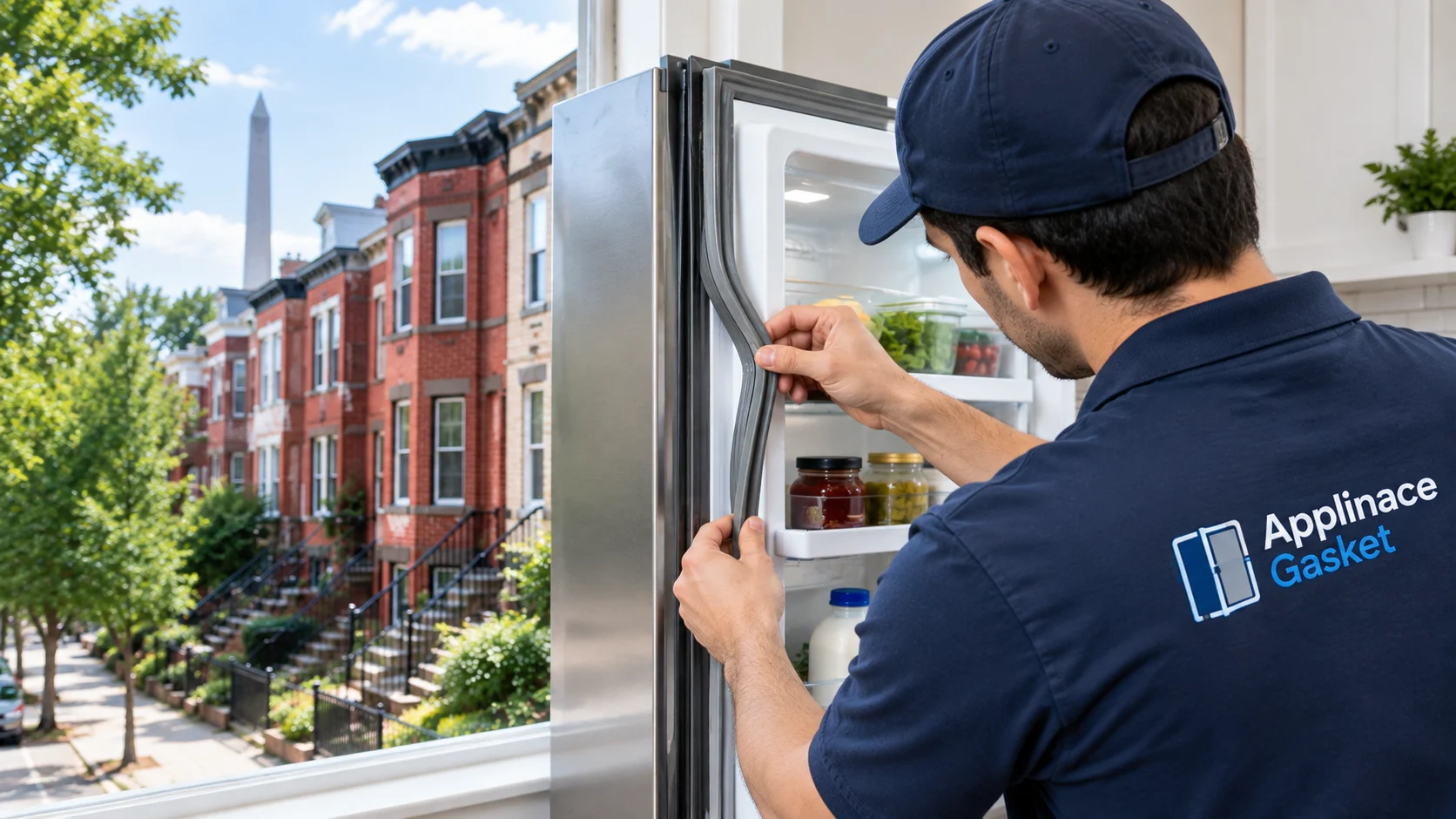
Refrigerator door gaskets wear out faster in DC rowhouse kitchens because tight galley layouts force repeated contact between the door and surrounding cabinetry, and the typical DC home was built around 1960, often with a refrigerator running an aging or already-replaced seal. Here’s how to tell if that’s what’s happening in your kitchen.
Key takeaways
- The median DC home was built around 1960, according to Census Bureau data, which means a lot of kitchens are still running refrigerators with original or long-degraded door seals.
- Tight rowhouse galley kitchens force the fridge door to swing and brush against cabinetry repeatedly, wearing down the gasket faster than in an open kitchen.
- A failing gasket mimics a dying fridge: rising energy bills, frost buildup, and food spoiling faster, but it’s usually a $100 to $300 fix, not a reason to buy a new appliance.
- Refrigerators over 15 years old can cost about $95 a year more to run, and older units use roughly 20% more energy than an ENERGY STAR certified model, according to ENERGY STAR.
- The dollar-bill test tells you in under a minute whether the seal, not the fridge, is the real problem.
- Appliance Gasket services Petworth, Logan Circle, Capitol Hill, Brookland, Georgetown, and the rest of the DMV with same-day gasket replacement, no diagnostic fee.
Why do DC rowhouse kitchens wear out refrigerator gaskets faster than other homes?
DC rowhouse kitchens wear out refrigerator gaskets faster mainly because of the housing stock’s age combined with tight layouts that were never designed around a modern refrigerator’s footprint. According to the U.S. Census Bureau’s American Community Survey (Table B25035, Median Year Structure Built), the typical home in the District of Columbia was built around 1960. A house that age has usually gone through several refrigerators, and the seal on whichever one is running now is rarely original equipment. Older seals dry out, flatten, and lose their grip long before anyone notices a problem with cooling.
Layer a narrow galley kitchen on top of that and the wear accelerates. Rowhouse kitchens are typically boxed in by load-bearing party walls shared with the house next door, which limits how much clearance the refrigerator door actually has when it swings open. Every time the door brushes a cabinet edge or gets nudged shut against resistance, the rubber gasket absorbs the impact. Do that a few times a day for years and the seal breaks down well before a homeowner in a newer, wider kitchen would notice anything wrong.
How does a tight galley kitchen physically damage a door seal?
A tight galley kitchen damages a door seal mainly through repeated contact between the door and the cabinetry or wall it swings toward, which flattens and tears the rubber over time. Counter-depth refrigerators are common in rowhouses specifically because they sit flush with surrounding cabinets, but that snug fit means the door has less room to swing freely. Every open-and-close cycle in a cramped kitchen puts more mechanical stress on the corners of the gasket, which is exactly where seals fail first.
This shows up as uneven wear rather than one big failure. You might notice the seal on the hinge side, where the door swings hardest against a cabinet, feels harder or more cracked than the seal on the latch side. That kind of localized wear is a strong sign the kitchen’s layout, not just age, is behind the problem.
What are the signs the gasket, not the fridge, is the problem?
The clearest signs are a door that won’t stay shut on its own, condensation or frost forming inside the door or freezer, and an energy bill climbing for no obvious reason. Homeowners often assume these symptoms mean the compressor is failing, but a compressor working overtime to compensate for a leaking seal produces the exact same warning signs as a dying refrigerator.
Other signals to check: visible cracks, tears, or flattened rubber anywhere along the seal; food spoiling faster than it used to, especially in the door shelves; and a gasket that feels hard or brittle instead of soft and slightly tacky. If you’re seeing two or more of these, the seal is worth testing before you assume the fridge itself needs to go.
How do you test a refrigerator gasket in a tight rowhouse kitchen?
The fastest way is the dollar-bill test: close the refrigerator door on a dollar bill with part of it hanging out, then pull the bill out slowly. A healthy seal grips the bill with firm resistance. If it slides out easily at any point around the door, the seal has failed there. Test multiple spots around the entire perimeter, not just one corner, since rowhouse kitchens tend to wear seals unevenly on the hinge side first.
We cover the full step-by-step version of this test, including how to interpret partial resistance, in our guide to spotting a failing refrigerator door seal.
Why do older refrigerators in older DC homes fail seals faster?
Older refrigerators fail seals faster because the rubber compound itself degrades with age and heat cycling, regardless of how carefully the kitchen is used. ENERGY STAR notes that a refrigerator over 15 years old can cost about $95 a year more to run than a newer model, and that older units use roughly 20% more energy on average than an ENERGY STAR certified refrigerator. A worn gasket is one of the biggest contributors to that gap, since a leaking seal forces the compressor to run far more than it should.
In a house built around 1960, it’s common to find a refrigerator that’s already had one or two replacements, sometimes with a gasket that doesn’t perfectly match the door channel it’s installed in. A mismatched or aging gasket combined with a tight kitchen’s extra mechanical stress is a faster failure path than either problem on its own.
What does this cost to fix versus replacing the fridge in a DC rowhouse?
Replacing the gasket is almost always the cheaper fix. As Appliance Gasket puts it: the seal is a $150 fix, a new appliance is a $1,000 mistake. Here’s how the options typically compare:
| Option | Typical cost | Typical timeline |
| Professional gasket replacement (residential) | $100 to $300, depending on brand and model | Often same-day |
| DIY gasket replacement (parts only) | Varies by brand; phone-guided installation help available | Same day once the part arrives |
| Full refrigerator replacement | $600 to $3,000+ | Days to weeks, plus disposal of the old unit |
Before spending money on a new refrigerator because of a door that won’t stay shut, it’s worth getting the seal itself diagnosed. Most of the time, the fix is far smaller than the fridge.
What if your kitchen is too tight for a standard gasket installation?
If your kitchen’s layout makes a standard installation difficult, you have three practical options: order the gasket and install it yourself with phone-guided support, have a technician come do the full installation on site, or, for built-in and high-end units common in DC’s older homes, use a specialist familiar with panel-ready and counter-depth models. Appliance Gasket offers all three, including dedicated service for built-in and high-end brands like Sub-Zero, Wolf, and Miele, which are more common in rowhouse kitchens that were renovated with panel-ready appliances to fit tight cabinetry.
Send a photo of your gasket and your refrigerator’s model number before scheduling. That lets a technician confirm the exact part and installation approach for your kitchen’s layout before anyone shows up, which matters more in a rowhouse galley kitchen than in a standard-size kitchen with room to maneuver.
The bottom line
A refrigerator door that won’t stay sealed in a DC rowhouse kitchen is usually a gasket problem, not a fridge problem. The combination of an older housing stock and tight galley layouts wears seals down faster than in a typical suburban kitchen, but the fix is almost always a straightforward, inexpensive gasket replacement rather than a new appliance.
Get it fixed today
A worn gasket in a DC rowhouse kitchen is almost always a faster, cheaper fix than replacing the whole refrigerator. Send us a photo of your gasket and your refrigerator’s model number through our refrigerator gasket replacement service and get one exact price before any work starts, with no diagnostic fee.
If your kitchen has a built-in or panel-ready unit from a brand like Sub-Zero, Wolf, or Miele, our specialty and high-end appliance service is built around exactly this kind of tight installation. Every job, standard or specialty, comes with a 90-day warranty on parts and labor.
Contact Appliance Gasket to schedule same-day service across DC, Maryland, and Northern Virginia, including Petworth, Logan Circle, Capitol Hill, Brookland, and Georgetown. Call (202) 200-8501, Monday through Saturday, 8:00 am to 6:00 pm, or reach us anytime at Ilhamfraidoon@gmail.com or appliancegasket.com.
Appliance Gasket Fairfax City, VA 22031 (202) 200-8501
Frequently asked questions
Q1: Why won’t my refrigerator door seal properly in my old kitchen?
Usually it’s a combination of an aging gasket and a tight layout that puts extra mechanical stress on the seal every time the door opens and closes. Test it with the dollar-bill method described above to confirm.
Q2: Does a counter-depth refrigerator wear out gaskets faster than a standard-depth one?
Not on its own, but counter-depth units are more common in rowhouse kitchens specifically because of tight clearances, and those same clearances are what cause repeated door-to-cabinet contact that wears gaskets down faster.
Q3: Can the gasket be replaced without replacing the whole refrigerator?
Yes, in almost every case. A failing seal is one of the most common refrigerator problems and one of the cheapest to fix, typically far less than the cost of a new unit.
Q4: Does an old house make refrigerator repairs harder?
It can make installation trickier if the kitchen is tight or the unit is a built-in or panel-ready model, but it doesn’t change the repair itself. It just means the technician needs to account for less clearance.
Q5: How long does a refrigerator door gasket usually last?
Gaskets typically last 8 to 15 years under normal conditions, but repeated contact with cabinetry in a tight kitchen can shorten that.
Q6: How much does it cost to replace a refrigerator door gasket in DC, Maryland, or Northern Virginia?
Residential gasket replacement typically runs $100 to $300 depending on brand and model. Appliance Gasket provides one exact price after reviewing your model number, with no diagnostic fee.