Washer door gasket replacement typically costs between $150 and $400, depending on the washer’s brand and model. There is no single flat rate for this repair because a compact front-load boot and a commercial-grade seal are not the same part or the same job. Appliance Gasket quotes an exact price once it has your washer’s model number, with a $75–$95 diagnostic fee credited toward your repair.
Key takeaways
- Washer door gasket replacement generally runs $150 to $400 nationally, based on brand, model, and labor time
- There’s no flat rate. Pricing depends on the exact washer brand and model, not a generic service fee
- Front-load washers typically cost more to reseal than top-load machines because the door boot is a larger, more involved part
- Mold or a torn boot rarely means the washer needs replacing. A gasket swap restores it in most cases
- DIY parts cost less upfront, but a poorly seated boot is one of the most common reasons a “fixed” washer leaks again within weeks
- Appliance Gasket gives one exact price after you send your washer’s model number, with a $75–$95 diagnostic fee credited toward your repair
- Same-day gasket replacement is available across DC, Maryland, and Northern Virginia, including Fairfax, Bethesda, Silver Spring, and Rockville
- Call (202) 200-8501 for a free, model-based quote
How much does washer door gasket replacement cost?
Washer door gasket replacement generally costs $150 to $400, with most jobs landing in the $200 to $300 range once parts and labor are both counted. EasyBear Appliance Repair puts a washer door boot seal replacement at $170 to $370, averaging around $270. Angi reports washing machine repairs running $180 to $250 on average across its network, which lines up closely with a straightforward gasket swap.
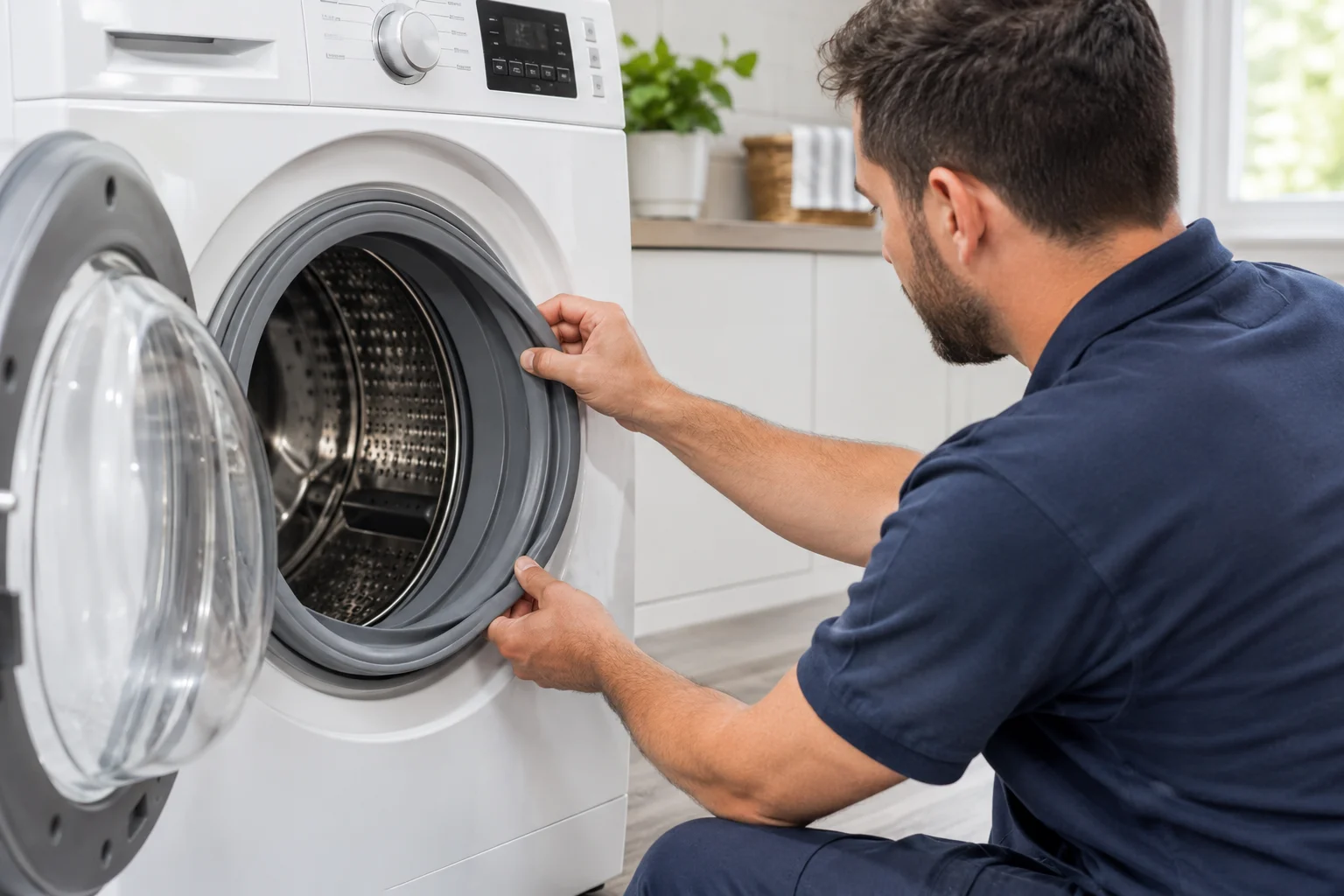
The part itself is usually the smaller piece of that number. A new door boot is a defined, inexpensive item once you know the exact brand and model. What drives the price up or down is labor: the boot has to come off without damaging the door frame, and the new one has to seat evenly around the entire ring. A seal that’s not seated correctly weeps at the bottom within days, which is why most of what you’re paying for is the technician’s time getting that seating right the first time.
That’s also why Appliance Gasket doesn’t quote a flat number up front. A Bosch compact boot and a commercial Speed Queen boot aren’t comparable jobs, so washer gasket replacement gets priced after you send your washer’s brand, model, and ZIP code. You get one exact price before any work starts, and the $75–$95 diagnostic fee is credited toward your repair.
Does washer door gasket replacement cost vary across DC, Maryland and Virginia?
Washer gasket pricing doesn’t change by city within the DMV the way it might with a company that charges separate travel fees for different zones. Appliance Gasket prices the job the same way everywhere it serves, from Fairfax and Falls Church to Silver Spring and Bethesda, because the price is set by the washer’s brand and model, not by which neighborhood the washer sits in.
What does change by location is how fast you can get someone out. A same-day appointment is realistic in most of the DC, Maryland, and Northern Virginia service area, covering Fairfax, McLean, Herndon, Reston, Chantilly, Centreville, Sterling, Woodbridge, Manassas, Leesburg, and Bristow in Northern Virginia; Silver Spring, Bethesda, Rockville, Potomac, Gaithersburg, and Takoma Park in the Maryland suburbs; and Washington DC neighborhoods from Georgetown and Logan Circle to Capitol Hill and Anacostia. A washer that’s actively leaking during a cycle gets prioritized over routine bookings, since standing water can reach flooring and subflooring fast if it sits for more than a day or two.
If you’re comparing quotes across the DMV, the thing worth asking isn’t “what’s your DC price versus your Maryland price.” It’s whether the quote is based on your actual washer’s model number or just a generic estimate. A real quote changes with the machine, not the ZIP code.
Why does washer gasket replacement cost vary by brand and model?
Washer gasket cost varies mainly because front-load and top-load washers use completely different seal designs, and even within front-load machines, the retaining system changes how long the job takes. A front-load washer’s door boot is a full rubber ring that wraps the entire drum opening, so replacing it is a more involved job than the small gasket used on most top-load machines, and it typically costs more as a result.
The retaining bands matter too. Some brands use a simple spring clamp that pops the boot into place relatively quickly. Others use an inner and outer band that both have to be tensioned evenly, which adds time to the job and pushes the price toward the higher end of the range. A universal-fit gasket bought online is one of the most common reasons a DIY or discount repair fails to hold a seal, since the curve and mounting channel have to match the exact model, not just the general size.
| Factor | Why it changes the price | Typical impact |
| Front-load vs. top-load | Front-load boots are larger and wrap the full drum opening | Front-load typically costs more |
| Retaining band style | Dual-band systems take longer to tension evenly than a single spring clamp | Adds labor time |
| Brand-specific part | Universal gaskets rarely seat correctly; OEM parts are matched to the exact model | Affects both part cost and long-term fit |
| Commercial vs. residential | Commercial-grade units like Speed Queen use heavier-duty boots built for daily cycles | Higher part and labor cost |
This is also why Appliance Gasket asks for your washer’s brand and model before quoting a price. A Samsung front-loader and a Whirlpool top-load fail at the seal differently, and pricing them the same way would mean either overcharging one customer or undercharging the harder job.
Is it cheaper to replace the gasket or the whole washer?
Replacing the gasket is almost always cheaper than replacing the washer. At $150 to $400 for a gasket against $500 to $1,500 or more for a new washer, a seal replacement is the far smaller expense, and it restores full function if the gasket is the only problem.
| Option | Typical cost | Makes sense when |
| Gasket replacement | 150–400 | The drum spins evenly, the door locks, and the only issue is the leak, smell, or torn rubber |
| New washer | 500–1,500+ | The gasket failure shows up alongside bearing noise, an unbalanced drum, or a control panel that’s already failed once |
A simple way to think about it: if the washer is under about six years old and the gasket is the only symptom, repair makes sense. If it’s past eight to ten years and showing more than one problem at once, a gasket swap only buys a little time before the next repair bill. Angi notes that washing machine repairs average $180 to $250, well under what most of a new washer purchase would cost, which is part of why a gasket alone rarely justifies replacing the whole machine.
Can I replace a washer door gasket myself to save money?
Replacing a washer door gasket yourself can save money on labor, but most DIY attempts end up needing a professional redo because the boot has to seat perfectly around the entire ring to hold a seal. The part alone, bought separately, is inexpensive compared to a fully installed job. The labor is where a DIY attempt usually runs into trouble.
The retaining bands are spring-tensioned or clamp-tensioned, and if the boot isn’t seated evenly all the way around, it weeps at the bottom during the next few cycles instead of leaking obviously right away. That delay is what makes DIY gasket jobs frustrating: the repair looks successful for a wash or two, then the leak comes back, and now you’re paying for a second visit on top of the part you already bought. A universal gasket, rather than one matched to your exact model, fails for the same reason: the curve and mounting channel don’t line up.
If you’re comfortable with the mechanical work and want to try it, matching the exact OEM part to your brand and model is the part most worth getting right, since that’s what determines whether the boot actually seats. If you’d rather not risk a second leak, a technician fitting and testing the seal before leaving removes that risk entirely.
Does a moldy washer gasket cost more to fix than a torn one?
A moldy washer gasket typically costs the same to replace as a torn one, since the repair itself is the same job either way. What changes the cost isn’t the mold itself, it’s how long the problem sits unaddressed. Moisture trapped in the gasket folds breeds mold, and once it’s set deep into the rubber, cleaning alone won’t fully remove it, which means the gasket has to come out regardless of whether it’s torn or just contaminated.
Where cost actually climbs is water damage. A washer leaking from the door for weeks can let water reach the flooring and subfloor underneath, turning a $150 to $400 gasket repair into a flooring repair that costs far more. That’s a separate expense from the gasket itself, and it’s avoidable simply by not waiting once you notice the smell or the leak. If you’re a renter dealing with a moldy washer seal and a landlord who isn’t moving on it, Virginia and Maryland each have specific timelines and remedies for getting it addressed.
The bottom line
Washer door gasket replacement runs $150 to $400 in most cases, with brand and model driving the exact number rather than your ZIP code within the DMV. A torn or moldy gasket is rarely a reason to replace the whole washer, and the biggest cost risk isn’t the repair itself, it’s waiting long enough for a leak to reach the flooring underneath. Appliance Gasket quotes one exact price after getting your washer’s model number, with a $75–$95 diagnostic fee credited toward your repair.
Get a free, model-based quote today
If your washer is leaking from the door or holding a smell that cleaning can’t reach, the gasket is almost always the cause, and replacing it is usually the smaller, faster fix compared to living with the problem or replacing the machine. Send your washer’s brand, model, and ZIP code and you’ll get one exact price before any work starts, with same-day appointments available across DC, Maryland, and Northern Virginia. Reach out to Appliance Gasket to get your quote started.
Appliance Gasket
Fairfax City , VA 22031
Phone: (202) 200-8501
Email: Ilhamfraidoon@gmail.com
Frequently asked questions
Q1: How much does it cost to replace a washer gasket?
Washer gasket replacement typically costs $150 to $400, with most jobs falling between $200 and $300 once parts and labor are both included. The exact price depends on the washer’s brand and model, which is why Appliance Gasket quotes it after getting that information rather than using one flat rate.
Q2: Is it cheaper to fix a washer or replace it?
Fixing a washer with a gasket problem is almost always cheaper than replacing it. A gasket runs $150 to $400 installed, while a new washer typically costs $500 to $1,500 or more, so repair makes sense unless the washer has other problems alongside the seal.
Q3: What is the most expensive part to replace on a washing machine?
A washer door gasket is on the more affordable end of washer repairs compared to major components like the motor, control board, or drum bearings, which involve more labor and more expensive parts. A gasket swap is usually a contained, single-part job rather than one that touches the washer’s mechanical core.
Q4: Is it worth replacing a washing machine gasket?
Replacing the gasket is worth it in most cases, since it’s a direct fix for a leak, a musty smell, or torn rubber, and it restores the washer to full working condition without touching anything else on the machine. It’s only not worth it if the washer is already failing in more than one place.
Q5: How much does it cost to replace a seal on a washing machine?
A washing machine seal, meaning the door gasket or boot, costs $150 to $400 to replace, similar to gasket replacement pricing generally since they’re the same part. Front-load machines tend to run toward the higher end of that range because the seal is larger and takes longer to fit correctly.
Q6: Can I still use my washing machine if the seal is broken?
You can usually still run a washer with a broken seal, but each cycle risks more water reaching the floor and more moisture feeding mold growth in the gasket folds. It’s not a safety hazard in most cases, but using it while the seal is torn tends to make the eventual repair and cleanup bigger, not smaller.