

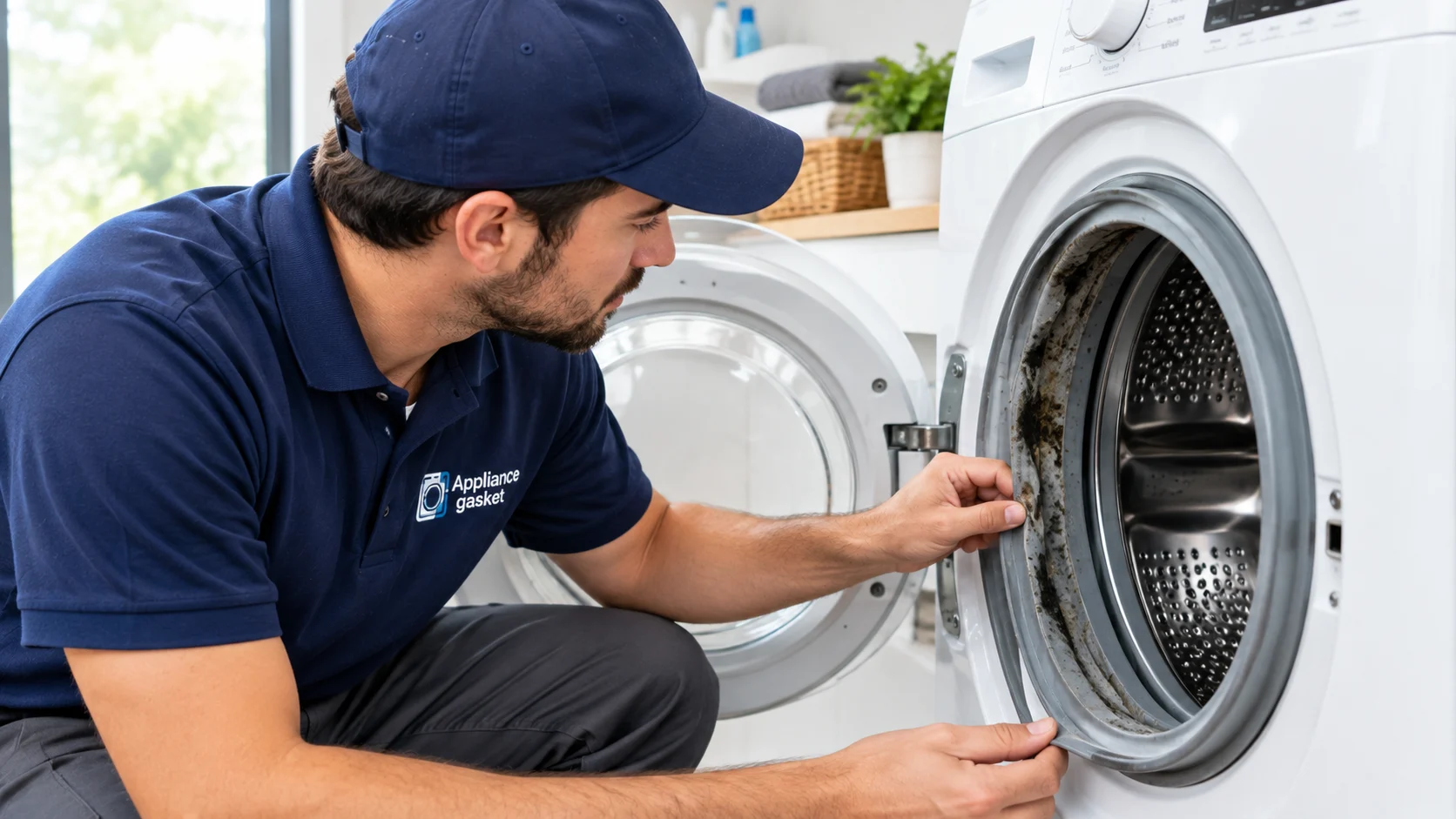
A landlord in Virginia or Maryland is generally required to fix mold on a washer door seal only when the mold comes from a defect, like a torn gasket, a blocked drain hose, or a ventilation problem the landlord knew about. Mold caused by leaving wet laundry in the drum or skipping routine cleaning is usually the tenant’s own responsibility, not the landlord’s.
TL;DR
- Defect-caused mold (torn gasket, leaking hose, ventilation issue) generally falls on the landlord under Virginia § 8.01-226.12 or Maryland’s Tenant Mold Protection Act.
- Neglect-caused mold (wet laundry left sitting, no wipe-downs) is usually on the tenant, and Virginia law specifically shields landlords from liability in that case.
- Maryland now gives landlords a hard 15-day window to assess and fix mold after written notice. Virginia doesn’t set a fixed deadline, just an “ordinary care” standard.
- Not sure which one you’re dealing with? Call Appliance Gasket at (202) 200-8501 for a same-week gasket inspection in Virginia or Maryland.
What actually causes mold on a washer door seal?
Mold on a front-load washer’s rubber door seal comes down to five common causes, and only some of them are the landlord’s problem. Trapped moisture from a normal wash cycle sitting in the gasket fold is usually a cleaning issue. Wet laundry left in the drum for hours or days feeds mold the same way. A torn or cracked gasket that traps standing water instead of draining it is a defect. A blocked or kinked drain hose that backs water up into the seal is a defect. Poor ventilation in a laundry closet or basement, especially one the landlord installed without an exhaust fan or window, is also generally treated as a landlord issue in Maryland under the new mold law.
The pattern is simple once you see it: if the mold shows up because water can’t leave the machine or the room, that’s usually mechanical or structural, which points to the landlord. If it shows up because water sat there and nobody wiped it out, that points to you. It’s the same logic behind how a torn refrigerator gasket traps cold air and fails the same dollar-bill test, just applied to moisture instead of temperature.
Tenant responsibility vs. landlord responsibility
Here’s how the most common causes break down under Virginia and Maryland law.
| Cause | Who’s responsible | Governing law |
| Wet laundry left in the drum | Tenant | General maintenance duty in your lease |
| Not wiping the gasket fold after cycles | Tenant | General maintenance duty in your lease |
| Torn or cracked door gasket | Landlord | VA § 8.01-226.12 / MD Tenant Mold Protection Act |
| Blocked or leaking drain hose | Landlord | VA § 8.01-226.12 / MD Tenant Mold Protection Act |
| Landlord-installed unit with no ventilation | Landlord | MD Tenant Mold Protection Act |
| Mold present at move-in | Landlord | VA § 8.01-226.12 / MD Tenant Mold Protection Act |
If you’re renting in Virginia or Maryland and need a professional washer gasket replacement to fix the actual defect, that’s the fastest way to stop the mold from coming back, regardless of who ends up paying for it.
Virginia’s mold law: what § 8.01-226.12 actually requires
Virginia doesn’t set a fixed number of days for a landlord to fix mold. Instead, Virginia Code § 8.01-226.12 requires the landlord or managing agent to remediate visible mold “exercising ordinary care” once they know about it, without naming a specific deadline the way Maryland now does.
The statute cuts both ways, though, and this is the part renters often miss. Subsection B says a landlord is not civilly liable for mold exposure claims if the mold condition is “caused solely by the negligence of the tenant.” In plain terms, if you’re the one who let wet towels sit in the machine for a week, Virginia law protects your landlord from a mold-related claim over that. The law also gives you a five-day window after move-in to dispute a written inspection report that shows no visible mold; if you don’t object in writing within five days, there’s a rebuttable presumption that no mold existed when you moved in, which matters if mold shows up later and you need to prove it wasn’t already there.
Maryland’s Tenant Mold Protection Act: the 15-day rule
Maryland gives landlords a specific deadline that Virginia doesn’t. Under the Tenant Mold Protection Act (Senate Bill 856, Chapter 539, effective July 1, 2025), a landlord must perform a mold assessment and complete mold remediation within 15 days after receiving written notice that mold has been detected in the unit.
That 15-day window is one of the clearest, most citable numbers in either state’s mold law right now, and it only applies once you’ve put the notice in writing. A verbal mention to a property manager doesn’t start the clock the same way. The law also requires landlords to provide tenants with information about mold risks and reporting at specific points, developed jointly by Maryland’s Department of the Environment, Department of Health, and Department of Housing and Community Development. If you’re weighing whether a similar clock applies to other appliance issues, we cover the same landlord-tenant question for a broken fridge seal across DC, Maryland, and Virginia, where the timelines differ by state in a similar way.
When it’s on you: cleaning habits that cause seal mold
Routine mold in the gasket fold usually traces back to four habits, and fixing them costs nothing. Wipe the rubber fold dry after every wash, since that’s where water pools longest. Leave the door cracked open between loads instead of sealing in humidity. Run an empty hot-water cycle with a washer cleaner tablet once a month to clear out residue building up behind the seal. Check the fold for stray coins, lint, or debris that traps water in one spot.
None of this is complicated, but skipping it is exactly the kind of “negligence of the tenant” Virginia’s statute points to, and it’s the reason a landlord can reasonably push back if you report mold without having done any of it first.
How to tell your landlord it’s a defect, not neglect
The strongest way to prove defect-caused mold is photo documentation plus a written notice, not a phone call. Photograph the torn or cracked section of the gasket clearly, note the date you first noticed it, and check whether water pools or drains slowly when you run a cycle. Then send the notice in writing, by email or letter, rather than mentioning it in passing, since both Virginia and Maryland’s laws are triggered by written notice specifically. Keep a copy for yourself.
If you’re not sure whether what you’re looking at is a defect or just buildup, reach out to Appliance Gasket through our contact page and we can walk through what you’re seeing before you send anything to your landlord.
What happens if your landlord ignores a defect-caused mold problem
In Maryland, if a landlord misses the 15-day assessment-and-remediation window after written notice, that’s a direct violation of the Tenant Mold Protection Act, and it’s worth documenting the date your notice was sent alongside the date the 15 days lapsed. In Virginia, since there’s no fixed deadline, “ordinary care” is judged more loosely, but ignoring a documented defect for weeks or months generally isn’t ordinary care by any reasonable standard.
This isn’t legal advice, and every lease and situation is different. If your landlord isn’t responding, Virginia’s Residential Landlord and Tenant Act and Maryland’s tenant protections both offer paths forward, but a licensed attorney or your local tenant rights office can tell you which one fits your specific case.
Fixing the gasket before mold becomes a bigger problem
Replacing a torn or failing washer door gasket typically costs far less than dealing with mold damage that keeps coming back, and it removes the root cause instead of just cleaning the surface. Whether you’re a tenant asking your landlord to fix it or a landlord who wants it handled fast and documented, Appliance Gasket’s washer gasket replacement service covers Virginia and Maryland with same-week appointments.
The bottom line
Mold on a washer door seal splits along one line: did it come from a mechanical defect, or from water that sat there because nobody dealt with it? Defect-caused mold is generally the landlord’s responsibility under Virginia § 8.01-226.12 or Maryland’s Tenant Mold Protection Act, with Maryland now giving landlords a firm 15-day clock. Neglect-caused mold is usually on the tenant, and Virginia law specifically protects landlords from liability in that case. Document what you find, put it in writing, and get the seal itself fixed either way.
Get your washer seal fixed today
Whether the mold on your washer’s door seal turns out to be a landlord’s responsibility or your own, the fastest way to stop it for good is replacing the gasket itself. Appliance Gasket handles washer gasket replacement across Virginia and Maryland with same-week appointments, and we’ll tell you plainly whether what we find looks like a defect or routine wear, so you have something concrete to bring to your landlord or your tenant either way. Reach out through our contact page with your model number and we’ll get you scheduled. Most jobs are done in under an hour, with no diagnostic fee.
Appliance Gasket
Call: (202) 200-8501
Fairfax City, VA 22031
Frequently asked questions
Q1: Can I withhold rent over a moldy washer seal in Virginia or Maryland?
Only by following your state’s formal process, not by simply stopping payments. Virginia and Maryland each have specific tenant remedies tied to documented notice and a landlord’s failure to act, and skipping that process can expose you to an eviction claim.
Q2: Does renters insurance cover mold damage from a washer seal?
Sometimes, but it depends heavily on your policy and whether the mold is classified as sudden damage or gradual neglect. Most policies exclude mold that resulted from a maintenance issue you didn’t report, so check your policy’s mold exclusion language directly.
Q3: Is black mold on a washer gasket dangerous?
Any visible mold should be treated seriously and cleaned or remediated promptly, regardless of color, since mold species can be hard to identify by sight alone. If you’re unsure, treat it as a health concern first and a responsibility question second.
Q4: How do I know if my washer gasket needs replacing instead of just cleaning?
If the mold and residue come back within a week or two of a thorough cleaning, or if you can see a tear, crack, or gap in the rubber fold, the gasket itself has likely failed and cleaning alone won’t solve it.
Q5: How many days does a Maryland landlord have to fix mold after I report it?
Fifteen days from the date the landlord receives your written notice, under the Tenant Mold Protection Act that took effect July 1, 2025. That clock only starts once the notice is in writing.
Q6: Does Maryland’s mold law apply if my lease is in Virginia?
No. Maryland’s Tenant Mold Protection Act only applies to units located in Maryland. A Virginia lease falls under Virginia § 8.01-226.12 instead, which doesn’t set the same fixed deadline.
Q7: Can my landlord charge me for mold they say I caused?
Possibly, if they can show the mold resulted solely from your negligence rather than a defect, which is part of why Virginia’s law specifically protects landlords in that situation. Documentation of the actual cause matters for both sides.