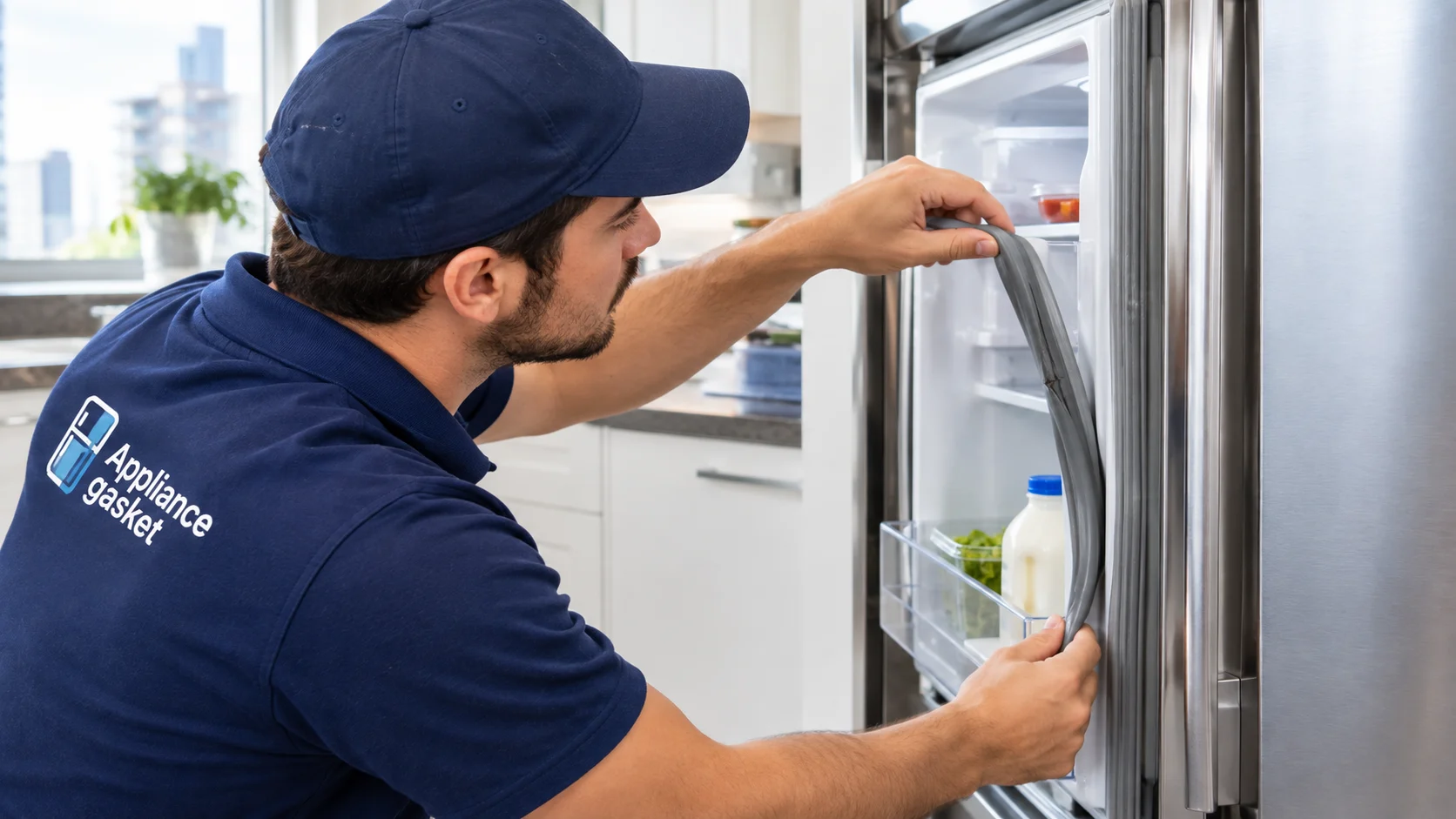
Whether your landlord has to fix a broken refrigerator seal depends on where you rent. DC and Virginia law generally puts the repair on the landlord if they supplied the fridge. Maryland law doesn’t require landlords to provide or maintain kitchen appliances at all, so your lease decides.
Key takeaways
- DC and Virginia landlords must generally maintain a refrigerator they supplied. Maryland has no such legal requirement for kitchen appliances.
- Check your lease first. It can shift responsibility for appliance repairs to you, no matter what your state’s default rule says.
- DC ties repairs to a 10-day complaint process, Maryland to a “reasonable time” standard, and Virginia to a 30-day presumption once you’ve given written notice.
- A worn or torn seal is a maintenance issue, not tenant damage, unless you caused it yourself.
- Once responsibility is settled, gasket replacement runs $50 to $440 nationally according to HomeAdvisor. Appliance Gasket quotes one exact price per refrigerator model, with no flat rate.
DC vs. Maryland vs. Virginia, at a glance
| Washington DC | Maryland | Virginia | |
| Must landlord provide a fridge? | Not required, but any fridge supplied must be kept working. | Not required. Md. Code, Real Property § 8-211(e) specifically excludes kitchen appliances. | Not required, but any appliance the landlord does supply falls under their maintenance duty. |
| Must landlord fix a broken seal? | Yes, if the fridge was supplied, under DC’s housing code. | No general legal requirement. A worn seal alone usually isn’t the kind of serious health or safety defect the law targets, unless your lease says otherwise. | Yes. Virginia Code § 55.1-1220 requires landlords to maintain appliances “supplied or required to be supplied by him.” |
| Typical repair-response process | Report it to your landlord, then file a complaint with DC’s Department of Buildings if it’s not fixed within 10 days (24 hours for emergencies). An inspection follows within 15 business days. | Give written, actual, or agency notice. The landlord then gets a “reasonable” period to fix serious defects, under the Tenant Safety Act of 2024. | Give written notice. Under § 55.1-1244, a landlord who hasn’t fixed a serious condition within 30 days of notice is presumed to have delayed unreasonably. |
| Tenant’s remedy if ignored | A Notice of Infraction gives the landlord 60 days for non-emergency fixes, 24 hours for emergencies. | Sue for damages and rent abatement, or refuse to pay rent, under the Tenant Safety Act. | File a tenant’s assertion in court and pay rent into a court escrow account while a judge orders the repair. |
Who is responsible for a broken refrigerator seal in a rental?
In most rentals, whoever supplied the refrigerator is responsible for keeping its door seal in working order, unless your lease specifically says otherwise. If your landlord provided the fridge as part of the unit, the seal falls under their general duty to maintain the appliances they supply. If you brought your own refrigerator, its upkeep is on you.
This baseline rule holds across DC, Maryland, and Virginia, but each state defines and enforces “landlord duty to maintain” differently, which is why the same broken seal can mean a fast legal fix in one state and a lease-dependent gray area in another. A torn or hardened gasket is a maintenance problem caused by normal wear, not damage you caused, so it shouldn’t be treated the same as, say, a shelf you cracked yourself.
Before you raise the issue with your landlord, it helps to confirm the seal is actually the problem and not something else going on with the fridge. A quick way to check is the classic dollar-bill test: close the door on a dollar bill and see how easily it pulls out. If it slides free with little resistance, you’re dealing with a seal issue, and the sections below walk through what your landlord owes you in each of the three jurisdictions.
Is my DC landlord responsible for fixing a broken fridge seal?
Yes. If your DC landlord supplied the refrigerator, the city’s housing code requires them to keep the door seal in working order. DC law treats a broken appliance the same as any other repair issue under the landlord’s habitability duty: report it, give them a chance to fix it, and escalate if they don’t.
The process itself is spelled out by DC’s Department of Buildings. Report the problem to your landlord or property manager first. If it isn’t fixed within 10 days, or within 24 hours for an emergency issue like no heat or utilities, you can file a complaint with DOB. From there, an inspection is scheduled within 15 business days, and if the inspector confirms a violation, DOB issues a Notice of Infraction. That notice gives the landlord 60 days to fix non-emergency issues, or 24 hours for emergencies.
This kind of seal failure comes up often in DC’s older housing stock. In fact, DC rowhouse kitchens tend to wear out gaskets faster than newer construction, thanks to tight galley layouts that put the fridge closer to a stove or radiator than it should be. If that’s your situation, the seal issue may keep coming back even after a single repair, which is worth mentioning when you report it to your landlord.
Is my Maryland landlord responsible for a broken refrigerator seal?
No, not automatically. Maryland doesn’t require landlords to provide or maintain kitchen appliances at all. Under Md. Code, Real Property § 8-211(e), the refrigerator, along with the dishwasher, stove, oven, and microwave, is specifically excluded from a landlord’s baseline legal duties.
That doesn’t mean you have zero recourse. Maryland’s Tenant Safety Act of 2024, codified at Real Property § 8-212, requires every rental unit to be fit for human habitation, and a landlord who’s given written, actual, or agency notice of a serious defect has to fix it within a reasonable time. The catch is that “serious” under this law generally means a fire risk or a real danger to health and safety, and a single worn gasket usually doesn’t clear that bar on its own, especially if the rest of the refrigerator still runs. If the fridge has stopped cooling entirely because of the seal failure, that’s a stronger case for habitability relief than a seal that’s simply lost some grip.
In practice, this means your Maryland lease does most of the work. If the lease says the landlord provides and maintains the refrigerator, that promise generally holds even though the law itself doesn’t require it. If the lease is silent or puts appliances on you, Maryland’s default rule leaves you covering the repair yourself.
Is my Virginia landlord responsible for fixing a broken fridge seal?
Yes. Virginia law is more direct than Maryland’s on this point. Under Virginia Code § 55.1-1220, a landlord must maintain in good and safe working order all appliances “supplied or required to be supplied by him,” which covers a refrigerator the landlord provided as part of the rental.
If your Virginia landlord isn’t responding, the law gives you a formal path forward. Under § 55.1-1244, you can send written notice of the problem, and if your landlord hasn’t remedied it within 30 days, the delay is presumed unreasonable by the court. At that point you can file a tenant’s assertion in general district court and pay your rent into a court-supervised escrow account instead of directly to your landlord, with the funds released once the repair is verified. It’s worth noting this statute is also the one that governs Virginia’s rent escrow process generally, not a repair deadline written into your lease, so the 30-day figure is a legal presumption a court applies, not a guarantee your landlord will move that fast on their own.
What if my lease says I’m responsible for appliance repairs?
If your lease specifically names you as responsible for appliance repairs, that clause usually controls, regardless of what your state’s default rule says. Landlords in all three jurisdictions can shift certain maintenance duties onto tenants through the lease, and a broken fridge seal often falls into that gray area unless local law explicitly forbids the shift.
Some leases go further than a blanket clause and cap the landlord’s responsibility at a dollar amount, so repairs under, say, $75 become the tenant’s problem by default. Read your lease’s maintenance and repair section closely before assuming either the state default or your landlord’s word applies. If the lease doesn’t mention appliances at all, you’re generally back to the state rules covered above.
This article explains general landlord-tenant rules and isn’t legal advice. Your actual lease terms, and the tenant-rights office or attorney in your jurisdiction, are the right place to confirm how this applies to your specific situation.
How long does a landlord have to fix a broken refrigerator seal?
It depends on the state. DC ties the timeline to its complaint process: 10 days after you report it (24 hours for emergencies), then 15 business days for an inspection, then up to 60 days after a Notice of Infraction. Maryland uses a general “reasonable time” standard under the Tenant Safety Act, decided case by case rather than a fixed number of days. Virginia presumes a delay unreasonable once 30 days have passed since written notice, under its rent escrow statute.
None of these timelines start until you’ve actually notified your landlord, ideally in writing, so the clock is in your hands to some degree. Once responsibility for the repair is clear and you just need the part replaced, you don’t have to wait on a legal process at all. You can have the seal itself replaced the same day in most cases, which is often faster than any of the formal timelines above, especially if your landlord has already agreed to cover the cost.
How much does it cost to replace a refrigerator gasket once responsibility is settled?
Refrigerator door seal replacement typically runs $50 to $440 nationally, according to HomeAdvisor (updated June 2026), with the range driven mostly by the refrigerator’s brand and model rather than the labor itself. A basic seal on a common model sits toward the lower end, while a built-in or commercial-grade refrigerator’s gasket pushes toward the higher end.
Appliance Gasket doesn’t publish a flat rate for the same reason that national range is so wide: the gasket is a different part on every brand and model. Instead, you send your refrigerator’s model number, and you get one exact price before any work starts, with no diagnostic fee either way. If your landlord is the one paying, this makes it easy to get a number in front of them before they agree to cover it.
What should renters do if their landlord won’t fix a broken seal?
Start with a written repair request, even if you’ve already mentioned it verbally or in a text. A dated, written notice is what triggers the formal timelines in all three states, and it’s the evidence you’d need if the issue ever goes further. Keep a copy, along with any photos of the failed seal and a note of when you first noticed the problem.
If your landlord still doesn’t act, your options depend on where you live. In DC, that means filing a complaint with the Department of Buildings. In Maryland, it means deciding whether the issue is serious enough to invoke the Tenant Safety Act, or whether your lease already covers it. In Virginia, it means sending written notice and, after 30 days, considering a tenant’s assertion and rent escrow filing in court. In every case, going through the formal process is safer than simply withholding rent on your own, since doing that without following your state’s actual procedure can put you at risk in an eviction case.
Once your landlord agrees to fix it, or once you’ve confirmed the repair is on you, there’s no reason to wait. A worn gasket makes your refrigerator work harder every day it goes unfixed, which shows up on the energy bill before anything else does.
The bottom line
Who pays for a broken fridge seal comes down to two things: which state you’re renting in, and what your lease actually says. DC and Virginia both put the repair on a landlord who supplied the fridge, with a formal process if they ignore it. Maryland doesn’t require landlords to provide or maintain kitchen appliances at all, so your lease carries more weight there. Whichever side of that line you’re on, once responsibility is settled, replacing the seal itself is usually the fastest and least expensive fix available.
Get it fixed today
Once you know who’s responsible for your broken fridge seal, fixing it is the easy part. Appliance Gasket replaces refrigerator door seals across DC, Maryland, and Northern Virginia, with same-day appointments in most cases. Send a photo of your door seal and your refrigerator’s model number, and you’ll get one exact price before any work starts, with no diagnostic fee.
If you want to double check the seal has actually failed before you say anything to your landlord, the dollar-bill test walks you through it step by step. And if you’re renting in a DC rowhouse, this look at why those kitchens are especially hard on gaskets explains why the problem tends to come back.
Reach out through the contact page to schedule service. Call (202) 200-8501, Monday through Saturday, 8:00 am to 6:00 pm, or email Ilhamfraidoon@gmail.com anytime. You can also start online at appliancegasket.com.
Appliance Gasket Fairfax City, VA 22031 (202) 200-8501
Frequently asked questions
Q1: Does renters insurance cover spoiled food from a broken seal?
Sometimes. Most renters insurance policies cover food spoilage caused by a mechanical breakdown or power outage, but coverage depends on your specific policy and its limits. Check your policy’s food-spoilage provision before assuming it applies.
Q2: Can I withhold rent if my landlord won’t fix it?
Only by following your state’s actual process. DC, Maryland, and Virginia each have a formal path, whether that’s a DOB complaint, a Tenant Safety Act claim, or a court-supervised rent escrow filing, and simply stopping rent payments outside that process can expose you to an eviction claim.
Q3: Is a landlord required to provide a refrigerator in DC, Maryland, or Virginia?
No, none of the three states requires a landlord to supply a refrigerator. If one is supplied, though, DC and Virginia law require the landlord to keep it working, while Maryland leaves it mostly to the lease.
Q4: How can I tell if the gasket is actually the problem?
The dollar-bill test is the fastest check: close the door on a bill with part hanging out, then pull it slowly and feel for resistance. If it slides out easily at multiple points around the door, the seal has likely failed.
Q5: Can I replace the gasket myself if my landlord won’t?
In many cases, yes, since gaskets typically snap or screw into a channel around the door edge. Keep in mind that paying for it yourself may affect your ability to seek reimbursement or rent abatement later, so check your lease and local process first.
Q6: What counts as a “reasonable time” for repairs?
It varies by state. DC defines it through specific day counts in its complaint process. Virginia presumes 30 days without a fix is unreasonable once you’ve given written notice. Maryland doesn’t set a fixed number and instead leaves “reasonable” to be judged case by case.