

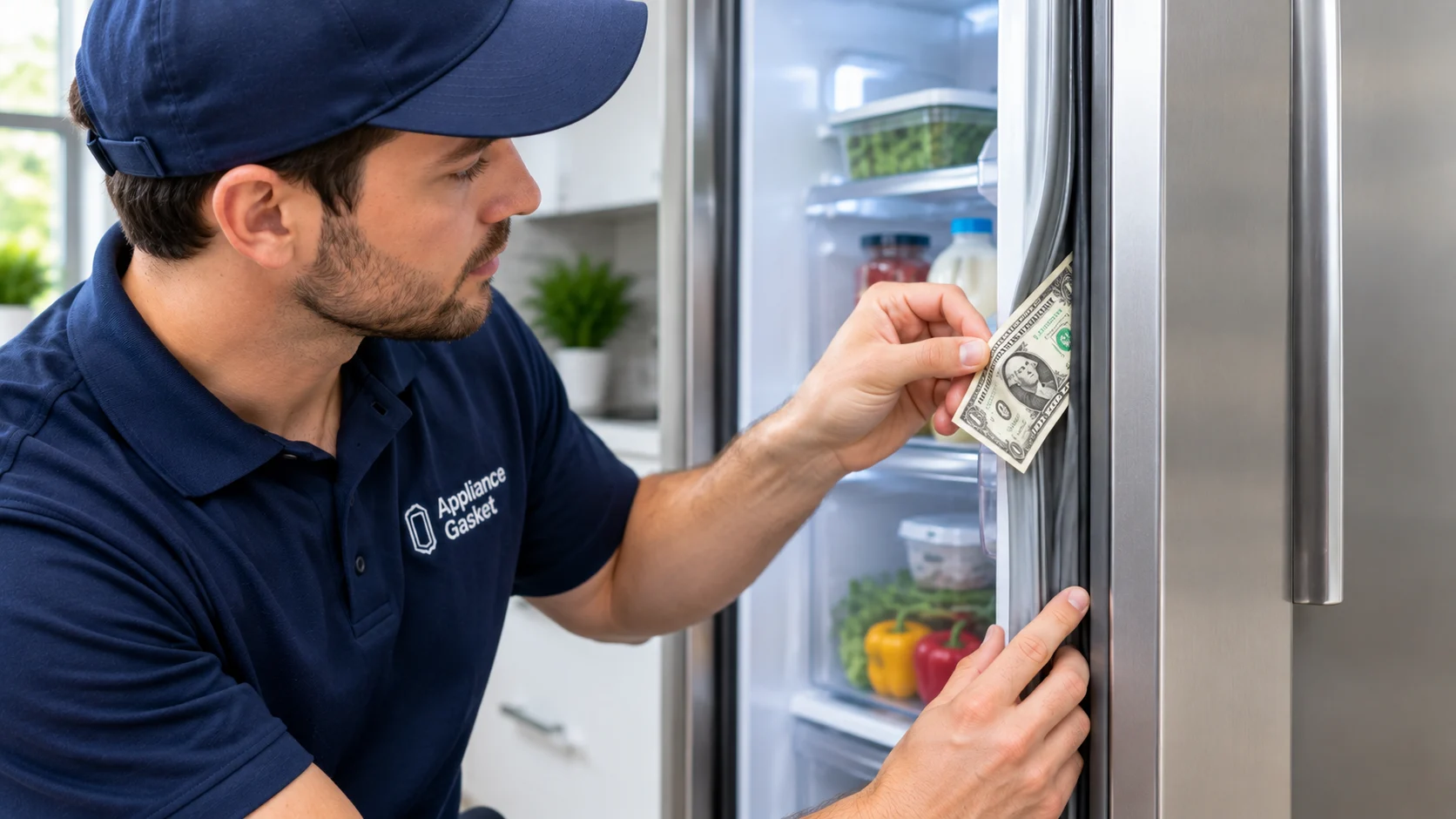
Close a dollar bill halfway in your refrigerator door, then pull it out slowly. If it slides free with little resistance, the door seal has lost its grip and cold air is escaping. If it drags and holds firm, the gasket is still doing its job.
Key takeaways
- The dollar-bill test measures whether the gasket’s magnetic strip and rubber still create an airtight grip on the door frame.
- A bill that slides out easily means the seal has failed at that spot. A bill that resists means the seal is holding.
- A dirty or greasy gasket can cause the same result as a worn one, so it’s worth cleaning the seal and retesting before assuming it needs to be replaced.
- Refrigerator door seal replacement runs $50 to $440 nationally, according to HomeAdvisor (updated June 2026), depending heavily on the brand and model.
- Appliance Gasket doesn’t quote a flat rate for this reason: the gasket differs by refrigerator model, so you send your model number and get one exact price before any work starts, with no diagnostic fee.
What is the dollar-bill test and why does it work?
The dollar-bill test works because a refrigerator door gasket relies on two things to hold a seal: a flexible rubber edge and a magnetic strip embedded inside it that pulls the door tight against the frame. When you trap a dollar bill between the gasket and the frame and pull, you’re directly measuring how much grip that magnetic strip and rubber still have left.
A healthy gasket compresses fully around the bill and holds it with steady friction the whole way out. That resistance comes from two things working together: the rubber pressing down evenly, and the magnet still pulling strong enough to keep that pressure constant. Once the rubber flattens, cracks, or the magnetic strip weakens with age, that grip drops off, and the bill slides free with little effort.
This is also why the test has to be done at multiple points, not just one. A gasket rarely fails evenly. The hinge side of the door takes the most repeated stress every time it opens and closes, so it often shows a weak result before the rest of the seal does. Testing only one spot can miss a failure that’s already affecting how well the door seals overall.
How do you do the dollar-bill test step by step?
Trap a dollar bill between the closed door and the gasket, then pull it out slowly while paying attention to how much resistance you feel. Here’s the full process:
- Take a dollar bill, or a similarly sized strip of paper if that’s what you have on hand.
- Open the refrigerator door and position the bill so about half of it hangs outside the door.
- Close the door on the bill, trapping the other half against the frame.
- Pull the bill out slowly and steadily. Don’t yank it, since a hard pull can make even a failing seal feel tighter than it is.
- Note the resistance. A good seal holds the bill firmly enough that you can feel real drag the entire time you’re pulling.
- Repeat the test at several points around the full perimeter of the door: top, bottom, and both sides, plus each corner.
If you have a French-door or side-by-side refrigerator, test each door separately, since the seals wear independently and one can fail well before the other.
What does it mean if the dollar bill slides out easily?
A dollar bill that slides out with little or no resistance means the seal isn’t gripping at that point, and cold air is very likely escaping there. This matters even if it only happens at one spot on an otherwise tight door, since a gap anywhere along the perimeter lets warm air in and forces the compressor to run longer to compensate.
Where the bill slides out easily tells you something too. A weak result at the hinge side alone often points to mechanical wear from the door’s own swing and contact with the frame. A weak result all the way around suggests the gasket itself has aged out, with the rubber flattened or the magnetic strip no longer holding charge. Either way, a consistent failure at the same spot across a few tries is the clearest sign that the seal, not the fridge, needs attention. The dollar-bill test is just one check, and it’s worth pairing it with the other signs a refrigerator door gasket has failed, like frost buildup or a climbing energy bill, before you decide the seal needs replacing.
Can the dollar-bill test give a false result?
Yes, a dirty or greasy gasket can cause the dollar bill to slide out easily even when the seal itself is still structurally sound, since grime on the rubber reduces the friction the test depends on. Before concluding the gasket needs replacing, wipe the entire seal down with warm water and mild soap, or a light vinegar solution, then let it dry fully and run the test again.
If the bill still slides out easily after a thorough cleaning, that’s a stronger sign the rubber or magnetic strip has actually failed rather than just gotten dirty. Skipping this cleaning step is the most common reason people assume a working gasket has failed. It’s a five-minute check that can save you from replacing a part that didn’t need it.
How much does it cost to replace a refrigerator gasket?
Refrigerator door seal replacement typically runs $50 to $440 nationally, according to HomeAdvisor (updated June 2026), with the wide range coming down to the refrigerator’s brand and model and whether you install it yourself or hire it out. The part itself is usually the cheaper piece of that range. What moves the price is how complex the door assembly is and whether a technician’s visit is included.
Appliance Gasket doesn’t publish a flat rate for the same reason the national range is so wide: the gasket is a different part on every brand and model, and a single number would either overcharge simple jobs or undercharge complicated ones. Instead, you send your refrigerator’s model number through the refrigerator gasket replacement service, and you get one exact price before any work starts, with no diagnostic fee either way.
Compare that to the cost of replacing the whole refrigerator, which typically starts well into the hundreds of dollars and climbs fast from there. If the compressor still runs and the door not sealing is the only issue the dollar-bill test confirms, replacing the gasket is nearly always the faster and cheaper fix.
The bottom line
The dollar-bill test gives you a fast, reliable read on whether your refrigerator’s door seal is still doing its job. Clean the gasket first to rule out a false result, then test the full perimeter of the door. If the bill keeps sliding out easily after that, the seal has failed and is worth replacing rather than the whole appliance.
Get it fixed today
If your refrigerator failed the dollar-bill test, replacing the gasket is one of the fastest, most affordable fixes available for a refrigerator, and Appliance Gasket handles it across DC, Maryland, and Northern Virginia with same-day appointments in most cases. Send a photo of your door seal and your refrigerator’s model number, and you’ll get one exact price before any work starts, with no diagnostic fee.
If you’re in a DC rowhouse or another tight kitchen layout, this breakdown of why those kitchens wear out gaskets faster covers the local angle in more depth.
Reach out through the contact page to schedule service. Call (202) 200-8501, Monday through Saturday, 8:00 am to 6:00 pm, or email Ilhamfraidoon@gmail.com anytime. You can also start online at appliancegasket.com.
Appliance Gasket Fairfax City, VA 22031 (202) 200-8501
Frequently asked questions
Q1: How can I test the gasket in my refrigerator?
The fastest way is the dollar-bill test: close the door on a dollar bill with part of it hanging out, then pull it out slowly and check the resistance. Test the full perimeter of the door, not just one spot.
Q2: How to tell if a refrigerator gasket is bad?
Look for visible cracks, flattened rubber, or a gasket that feels hard instead of soft and pliable, then confirm it with the dollar-bill test. A door that won’t stay shut on its own or visible frost inside the door are also signs worth checking.
Q3: Does Vaseline help refrigerator seals?
A thin layer of petroleum jelly can temporarily help a slightly dry gasket seal better, but it doesn’t fix a torn, cracked, or structurally worn seal. If the gasket fails the dollar-bill test after cleaning, petroleum jelly is a short-term patch, not a real fix.
Q4: How much does a refrigerator gasket cost?
Nationally, door seal replacement runs $50 to $440 depending on brand and model, according to HomeAdvisor. Appliance Gasket quotes an exact price per job rather than a flat rate, since the part differs by refrigerator model.
Q5: Are all fridge gaskets the same?
No. Gasket profiles, the channel they mount into, and the magnetic strip all vary by manufacturer and model, which is why a universal or mismatched gasket often still leaks air even after installation.
Q6: Can I replace a refrigerator gasket myself?
In many cases, yes, since most gaskets snap or screw into a channel around the door edge. The harder part is matching the exact gasket to your refrigerator’s brand and model, since a mismatched profile won’t hold a proper seal.