
A leak at the washer door usually means the door seal, but water pooling under the whole machine, especially during drain or spin, often points to the pump instead. When and where the water shows up, not just that it’s leaking, is what actually tells the two apart before anything gets replaced.
Key takeaways
- Water right at the door, during the wash cycle, usually means the seal. Water under the whole machine, especially during drain or spin, usually means the pump
- A real seal problem shows visible tearing, hardening, or debris trapped in the fold, not just a puddle nearby
- A pump leak often comes with a grinding or humming sound during drain, something a seal leak never produces
- Running a leaking washer a few more times to diagnose it is generally fine, but letting it go for weeks risks floor and cabinet damage
- Appliance Gasket quotes one exact price after getting your washer’s brand and model, with a $75–$95 diagnostic fee credited toward your repair, and offers same-day service across DC, Maryland, and Northern Virginia
- Call (202) 200-8501 for a model-based quote
Is the leak happening while filling, washing, draining, or spinning?
When the leak happens is the fastest way to narrow the cause. A leak during fill or wash points to the door seal, a leak during drain or spin points to the pump, and a leak that shows up even when the washer is off points to a hose or valve instead of either one.
| When it leaks | Likely cause | Why |
| During fill or wash, water at the door | Door seal | Seal is under direct pressure while the drum fills and agitates |
| During drain or spin, pooling underneath | Drain pump | Pump works hardest moving water out during these phases |
| Even when the washer is off or idle | Hose or valve, not seal or pump | Neither part is under pressure when the machine is idle |
This table is the fastest way to narrow things down before touching anything. A lot of older DC rowhouse basements and the utility closets common in established Maryland and Northern Virginia suburbs have laundry floors that aren’t perfectly level. That matters for this specific check, since gravity carries any leaked water toward the room’s low corner regardless of whether the seal or the pump is the actual source. Timing the leak to a specific cycle phase, not just looking at where the puddle ends up, is the more reliable method in these older installations.
How can I tell whether water is coming from the door seal?
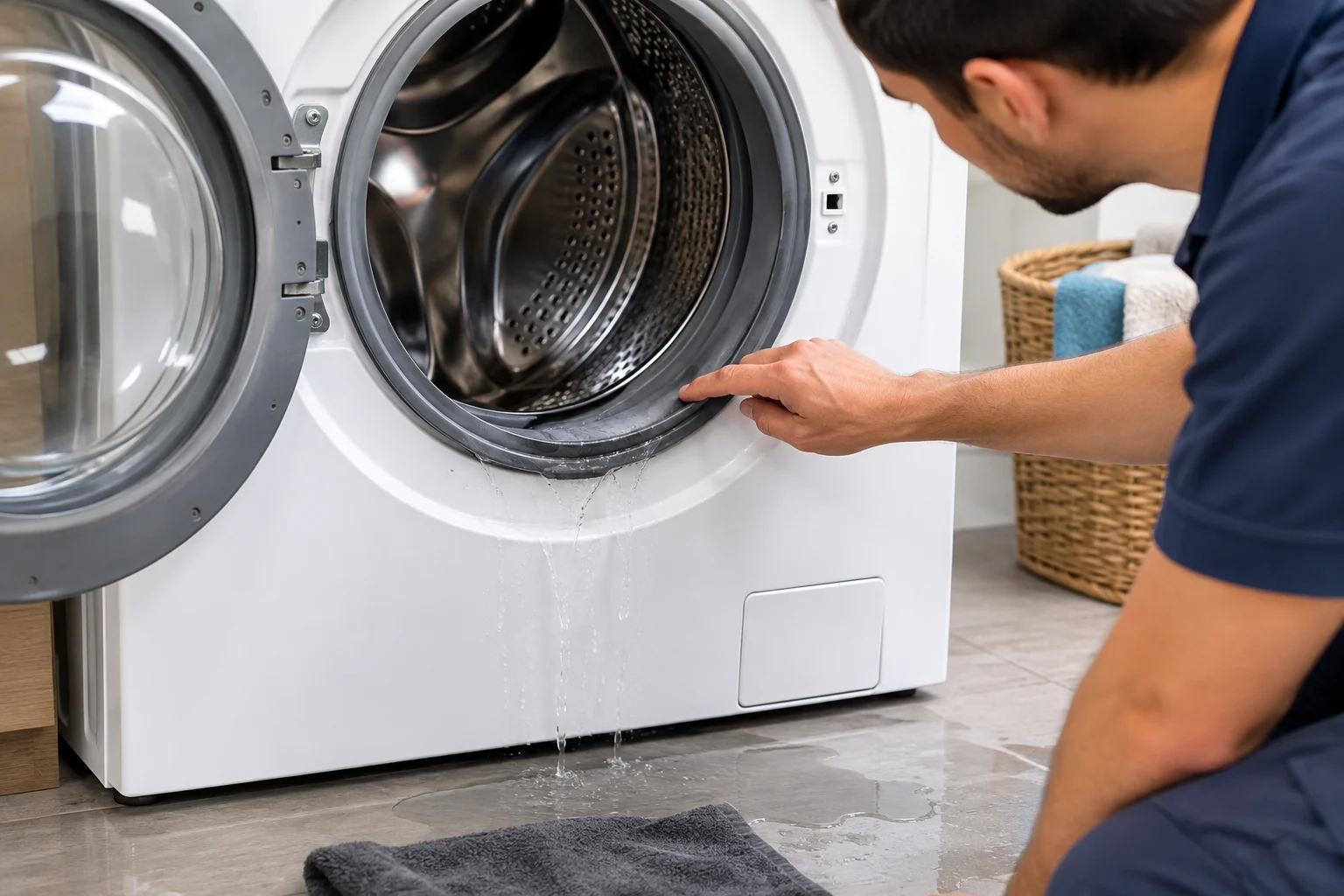
Water that appears specifically at the bottom corners of the door, during the wash cycle, with the fold of the gasket visibly damp, points to the seal. A dry gasket fold with water showing up somewhere else in the room is a sign to look past the seal before replacing it.
Open the door and run a finger along the inside of the fold while the machine is empty. If it feels dry and intact, that’s useful information on its own. Then watch the same spot during an actual wash cycle. A seal that’s genuinely leaking will show a visible bead or trickle of water forming right at the door frame while the drum is actively washing, not after the cycle ends and not from underneath the machine.
What does a pump leak look like versus a door-seal leak?
A pump leak pools under the whole machine, not concentrated at the door, almost always during the drain or spin portion of the cycle, and it’s often paired with a grinding, humming, or straining sound as the pump works. A seal leak never makes that sound and never pools evenly under the full footprint of the washer.
PartSelect’s own washer leak troubleshooting guide separates the drain pump from the door bellows, the tub cover gasket, and the tub seal as distinct leak sources, each with its own inspection point, which lines up with what shows up in real DC, Maryland, and Virginia laundry rooms: a washer that leaks only when it’s actively draining or spinning almost always has a pump or hose problem, not a seal problem, even if water happens to end up near the door by the time anyone notices it.
Seal leak signs:
- Water appears at the door
- Happens during the wash cycle
- No unusual sound
- Gasket fold is visibly damp
Pump leak signs:
- Water pools under the whole unit
- Happens during drain or spin
- Grinding or humming sound
- Gasket itself stays dry
How do I inspect the rubber door gasket for tears or damage?
Run a hand along the entire fold of the gasket, not just the visible outer edge, feeling for tears, hardened or brittle sections, or a spot where the rubber has pulled away from its channel. A seal that feels uniformly soft and flexible everywhere, with nothing trapped in the fold, is probably not the actual leak source even if water was seen nearby.
Washer door seals fold in on themselves, so a lot of damage that causes leaks sits in that inner fold rather than anywhere visible from a quick glance. Check for small punctures too, not just long tears. A hole as small as a pinprick from a zipper pull or an earring caught in a previous load can leak steadily during every wash without ever looking obviously damaged.
Is it safe to keep using a washing machine that leaks?
Running a leaking washer a few more loads while diagnosing the cause is generally fine, as long as water isn’t reaching anything electrical or pooling long enough to damage flooring or cabinets. A pump leak is worth addressing sooner than a minor seal leak, since a failing pump can also affect how well the washer drains, which compounds the problem with every load.
Letting any leak continue for weeks without checking it is what turns a simple seal or pump fix into a bigger repair. Standing water under the washer can eventually reach the subfloor or the cabinet base it sits against, and that damage costs far more to fix than the original part ever would have.
How much does replacing a washer door seal cost?
Cost depends on the washer’s brand and model, since the seal itself is priced differently across manufacturers and front-load gaskets vary more in size and shape than most people expect. For the full breakdown of what drives that cost up or down, Appliance Gasket’s washer gasket replacement cost guide for DC, MD and VA covers it in detail.
Pump replacement is a separate repair with its own cost, and it’s priced differently from a seal job since the labor involved is different. Rather than guessing at either number, confirming which part actually failed first is what keeps you from paying for a part that was never the problem.
Should I repair a leaking washer or replace the machine?
If the washer is otherwise working well and the leak traces to one part, the seal or the pump, repairing that part is almost always cheaper than replacing the entire machine. Replacement becomes the better call only when the washer is old, has already had multiple repairs, or the leak has caused damage that goes beyond the one failed part.
A washer that’s five or six years old with a single leaking seal is usually worth fixing. A washer pushing ten years with a pump failure on top of an earlier repair is a different conversation, and that’s where a technician who can actually see the machine’s condition gives a more useful answer than a general rule.
The checklist: seal or pump?
Replace the door seal when the rubber itself shows tearing, hardening, or debris trapped in the fold, and the leak happens specifically during fill or wash. Look at the pump when the seal checks out clean, the leak happens during drain or spin, and a grinding or humming sound comes with it.
Replace the seal if:
- The rubber shows visible tearing, hardening, or debris trapped in the fold
- The leak happens during fill or wash, not drain or spin
- No grinding or humming sound accompanies the leak
Look at the pump if:
- The gasket fold feels intact and dry everywhere
- The leak happens during drain or spin, or water pools under the whole unit
- A grinding or humming sound accompanies the leak
This is the single most useful passage in this whole post, because it’s the one thing no competitor content actually states this specifically. Most guides list seal and pump problems as separate sections without ever building a way to choose between them. This checklist is built to remove that guesswork.
The bottom line
Check when the leak happens first, inspect the seal itself, compare what you’re seeing against the signs of a pump leak, then run through the checklist above before assuming which part failed. If the checks don’t point clearly to one cause, or you’d rather not guess, that’s the point to get a model-based diagnosis. Appliance Gasket quotes one exact price after getting your washer’s brand and model, with a $75–$95 diagnostic fee credited toward your repair, and offers same-day service across DC, Maryland, and Northern Virginia.
Get your washer leak diagnosed in DC, MD & VA
If the checks above don’t give you a clear answer, the next step is a model-based diagnosis rather than guessing at parts. Appliance Gasket’s washer gasket repair and replacement service confirms from your washer’s model and the leak’s timing whether it’s the seal, the pump, or something else entirely.
Send your washer’s brand, model, and ZIP code and Appliance Gasket will quote one exact price with a $75–$95 diagnostic fee credited toward your repair, with same-day appointments available across Washington DC, Maryland, and Northern Virginia. If you’d rather talk through what you’re seeing before booking anything, reach out through our contact page and we’ll walk through it with you.
Appliance Gasket
Phone: (202) 200-8501
Email: Ilhamfraidoon@gmail.com
Address: Fairfax City, VA 22031
Serving Washington DC, Maryland & Northern Virginia
Frequently asked questions
Q1: Can too much detergent cause a leak that looks like a seal problem?
Yes, though indirectly. Excess suds from using too much detergent, or the wrong type for a high-efficiency washer, can force foam and water past the seal during the wash, which looks exactly like a seal failure even when the gasket itself is in good shape. Cutting back to the correct amount of HE detergent and watching the next wash is a quick way to rule this out before assuming the seal has failed.
Q2: Why does my washer only leak on some loads, not every wash?
An intermittent leak usually means the cause is load-dependent rather than a constant failure, like a heavy, bulky item that shifts against the door seal only with certain loads, or a pump that only struggles with a full drain cycle under a heavier wash. Paying attention to what’s different about the loads that leak versus the ones that don’t narrows the cause faster than waiting for it to happen every time.
Q3: Can an unlevel washer cause a door leak even with a good seal?
Yes. A washer that isn’t sitting level can cause water to pool unevenly against one side of the tub, which puts pressure on a section of the door seal that was never designed to hold back standing water, even when the gasket itself is undamaged. Checking the machine with a level, front to back and side to side, and adjusting the feet if needed, is worth doing before assuming the seal needs replacing.
Q4: Does a drain pump leak mean the pump needs full replacement, or can it be repaired?
It depends on where the leak originates. A loose hose clamp or a disconnected hose at the pump can often be fixed without replacing the pump itself, while a cracked pump housing or a failed seal inside the pump usually can’t be repaired and needs the whole unit swapped. A technician checking the actual connection points is the only reliable way to know which situation applies.
Q5: Is a musty smell a sign of a seal problem or something else?
A musty smell on its own points more often to mold building up in the folds of the door seal from trapped moisture than to an active leak, since mold produces odor whether or not water is actively escaping. If the smell shows up alongside an actual puddle or dampness outside the machine, that combination points toward a real leak rather than just surface mold.
Q6: How long does a washer door seal or pump replacement take?
A door seal replacement is typically a shorter job than a pump replacement, since the pump often sits behind a panel that takes more time to access and reinstall correctly. Both jobs are usually finished within the same appointment once the technician has confirmed which part actually failed and has the correct part on hand.