

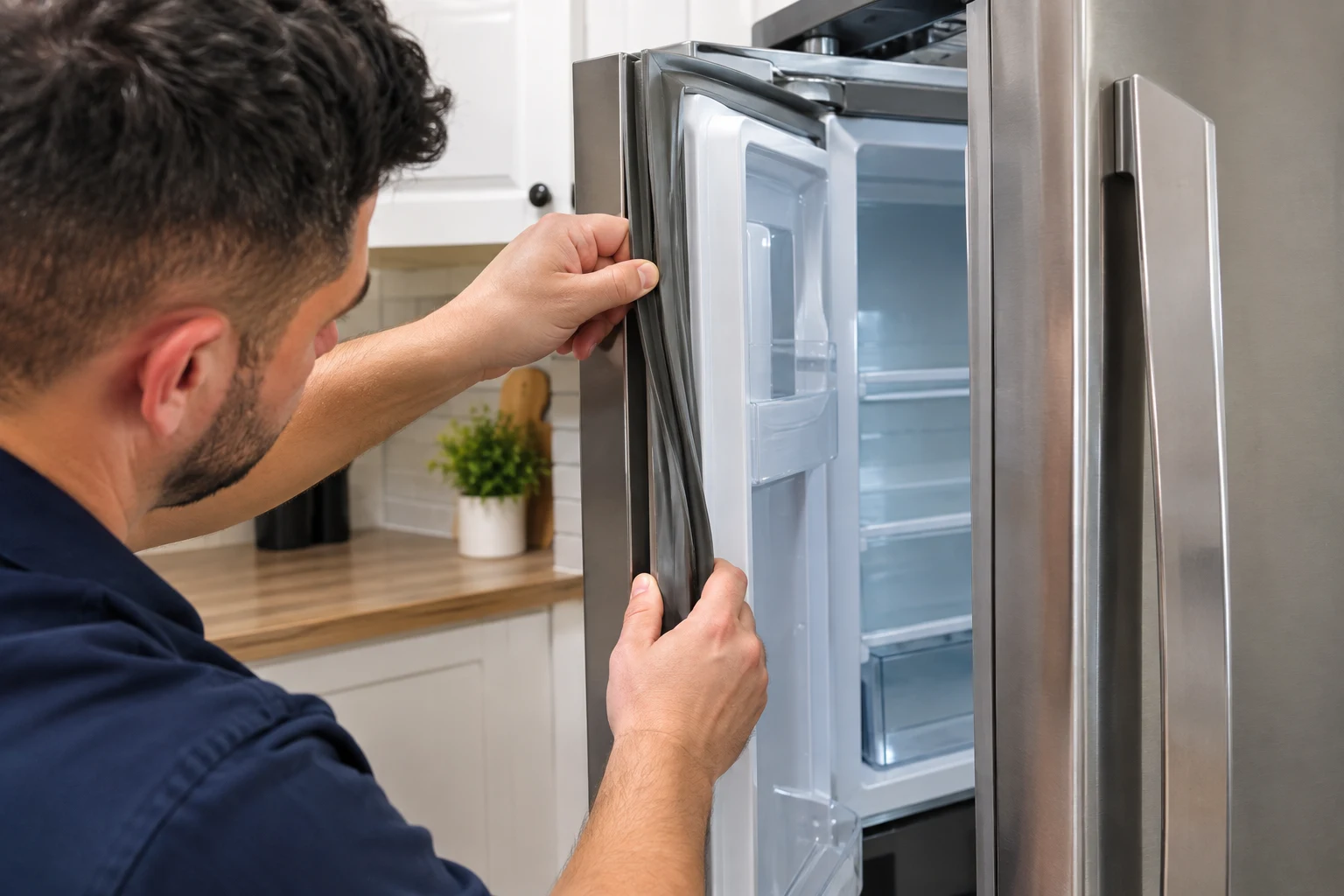
The most common Samsung refrigerator gasket problems are warping at the bottom corners of French-door models, mold buildup inside the fold, and a torn or loose seal that’s lost its shape. Each has a different fix, and the right one depends on whether the rubber is actually damaged or just out of position. Samsung’s French-door design puts extra strain on the bottom corners where two doors meet, which is why that spot fails more often than the rest of the seal.
Key takeaways
- The most common Samsung gasket problems are bottom-corner warping on French-door models, mold in the fold, torn rubber, and a gasket that’s lost its memory and won’t lie flat
- French-door Samsung models (the RF series) see more gasket complaints than single-door or side-by-side models because the seal has to meet at a center point between two doors
- A common OEM replacement part across several French-door models is DA63-05005A. Side-by-side and top-mount models use different part numbers, so matching the exact model matters
- A gasket that looks intact but won’t seal flat at the bottom corner is usually warped, not torn, and that’s a different repair
- Mold in a Samsung gasket fold is common in humid DMV summers and isn’t a sign anything else is failing
- Minor warping can sometimes be reshaped. A torn or fully warped gasket needs a matched OEM replacement, not a universal one
- Appliance Gasket quotes one exact price after getting the Samsung model number, with a $75–$95 diagnostic fee credited toward your repair, and offers same-day appointments across DC, Maryland, and Northern Virginia
- Call (202) 200-8501 for a model-based quote
What are the most common Samsung refrigerator door gasket problems?
The most common Samsung refrigerator gasket problems are a gap at the bottom corner on French-door models, mold or mildew sitting in the fold of the rubber, a torn or cracked seal, and a gasket that’s gone soft or saggy and won’t snap back into shape. Each shows up differently. A bottom-corner gap usually means warm air leaking in right where the two French doors meet, which is the spot that takes the most daily stress. Mold shows up as dark spotting inside the accordion-style fold, usually where moisture collects and doesn’t fully dry between door openings. A torn seal is visible rubber damage, often near a hinge or a corner that’s been caught or pinched. A gasket that’s lost its shape memory looks fine hanging but won’t lie flat against the cabinet once the door closes.
Samsung refrigerators, especially the French-door RF line, see this cluster of problems more than single-door units because the gasket geometry is more complex. Instead of one continuous seal around a single door, two separate door gaskets have to align and meet cleanly at the center, and any drift in either door throws off the seal at exactly the point where both halves depend on each other.
Why does a Samsung refrigerator door not seal properly?
A Samsung refrigerator door usually stops sealing because of hinge drift, debris trapped at the bottom fold, or rubber that’s stiffened with age and lost its flexibility. On French-door models specifically, the center meeting point between the two doors is the most sensitive part of the seal. If one door hangs even slightly lower than the other from hinge wear, the gasket at that corner never fully closes, and warm air pulls in every time the compressor cycles.
Food residue and ice buildup at the bottom of the gasket fold are another common cause, and one that’s easy to miss because the seal still looks fine from the front. A thin film of debris is enough to break the vacuum seal at that one point, even though the rest of the gasket is sealing normally. Age-related stiffening is the third cause. Rubber gaskets are flexible when new and gradually lose that give over several years, especially with constant opening and closing, which is heavier in a kitchen that sees daily use. A stiff gasket may still look straight but won’t compress enough to form a tight seal anymore.
How do you fix a Samsung refrigerator gasket that isn’t sealing?
A Samsung refrigerator gasket that isn’t sealing can sometimes be fixed by reshaping it with gentle heat, but a gasket that’s torn or fully warped needs a full replacement instead. The reshape approach works for minor warping only: warming the affected section with a hairdryer on low heat and gently pressing it back into its original curve can restore the seal if the rubber itself is still intact. This works because Samsung’s gasket material can be coaxed back toward its molded shape when the damage is just a bend, not a tear.
If reshaping doesn’t hold, or the gasket snaps back out of position within a day, the rubber has likely lost its memory for good and heat alone won’t fix it. Before assuming it needs a reshape or a replacement, it helps to actually confirm the seal is the problem and not something else entirely, which is where a simple paper or dollar-bill test comes in. If you haven’t already run that check, this quick test tells you in under a minute whether the gasket is genuinely the source of the leak before you spend time or money fixing the wrong part.
Which Samsung refrigerator models have the most gasket issues, and what part do they need?
Samsung’s French-door line (the RF series, including RF23, RF27, and RF28-class models) sees more gasket issues than the side-by-side or top-mount lines because the center-seal design has more points where alignment can drift. A commonly referenced OEM replacement part across several of these French-door models is DA63-05005A, which matches the curve and mounting channel specific to that door design. Side-by-side and top-mount Samsung refrigerators use a different gasket profile entirely, falling under the DA97 part family instead, so a part that fits one line won’t seat correctly on the other.
| Model type | Common failure point | Typical OEM part family |
| French-door (RF series) | Bottom-corner gap where two doors meet | DA63-05005A |
| Side-by-side | Vertical seal drift along the hinge side | DA97-series |
| Top-mount / single-door | General age-related stiffening, less center-seal stress | DA97-series |
This is the detail most gasket content skips entirely. A universal, non-Samsung gasket might look close enough to fit, but the mounting channel and the exact curve of the molded rubber are specific to the model line, which is exactly why a mismatched part looks fine on the shelf and still leaks once installed.
How much does Samsung refrigerator gasket replacement cost?
Samsung refrigerator gasket replacement typically runs in a similar range to general refrigerator seal repairs, which Angi reports averaging between $200 and $400 for a seal or gasket job, depending on the model and labor involved. EasyBear Appliance Repair has documented the Samsung-specific OEM part cost separately from labor, since French-door gaskets like the DA63-05005A tend to cost more than a standard single-door seal because of the two-piece, center-meeting design.
Appliance Gasket doesn’t quote a flat number up front for this reason. A Samsung French-door gasket and a basic top-mount seal aren’t the same job, so pricing is set after getting your refrigerator’s exact model number, with one quote and a $75–$95 diagnostic fee credited toward your repair.
Can you fix a Samsung refrigerator gasket yourself, or does it need a professional?
Minor warping on a Samsung refrigerator gasket is reasonable to try fixing yourself, but a torn or fully warped seal is better handled by a professional because the replacement has to seat evenly around the entire channel to hold. The reshape method, described earlier, is low-risk and doesn’t require removing anything, which makes it a fair first step before calling anyone.
Full replacement is where DIY attempts run into trouble. The new gasket has to seat into the mounting channel at an even tension all the way around, and on a French-door model, both doors have to align correctly with each other once the new seal is in place. An unevenly seated gasket often looks correct for the first few days, then starts leaking again once the rubber settles into its actual position. Buying a non-Samsung universal gasket instead of the matched OEM part is one of the most common reasons a self-installed seal fails to hold, since the channel profile has to match the exact model, not just the general door size.
Does a moldy Samsung refrigerator gasket need full replacement?
A moldy Samsung refrigerator gasket doesn’t always need full replacement if the mold is caught early and sitting on the surface of the rubber. A mix of warm water and mild soap, worked into the fold with a soft brush, can remove surface mold before it sets in. Once mold has worked into the rubber itself, though, cleaning won’t fully remove it, and the gasket needs to come out.
Humid summers across the DMV make this more common here than in drier climates, since moisture trapped in the gasket fold doesn’t fully evaporate between door openings. This comes up often in rental situations too, where a tenant notices the mold but isn’t sure who’s responsible for getting it fixed. If that’s your situation, Virginia and Maryland have specific rules about who handles a seal problem like this and how quickly it needs to be addressed.
The bottom line
Samsung refrigerator gasket problems almost always come down to one of four things: bottom-corner warping on French-door models, mold in the fold, a torn seal, or rubber that’s lost its shape. The fix depends on which one it is, and matching the exact OEM part to your model, rather than a universal gasket, is what makes a replacement actually hold. Appliance Gasket quotes one exact price after getting your Samsung model number, with a $75–$95 diagnostic fee credited toward your repair, and offers same-day service across DC, Maryland, and Northern Virginia.
Get a same-day Samsung gasket repair quote in DC, MD & VA
If your Samsung refrigerator door isn’t sealing, is growing mold in the fold, or has a visibly torn gasket, Appliance Gasket can get you one exact price after you send your model number and ZIP code, with a $75–$95 diagnostic fee credited toward your repair. Same-day appointments are available across Washington DC, Maryland, and Northern Virginia, so a leaking seal doesn’t have to sit for days before it’s fixed. Reach out through our contact page to get your quote started.
Appliance Gasket
Phone: (202) 200-8501
Email: Ilhamfraidoon@gmail.com
Address: Fairfax City, VA 22031
Serving Washington DC, Maryland & Northern Virginia
Frequently asked questions
Q1: Is Samsung refrigerator gasket replacement covered under warranty?
Samsung’s standard warranty typically covers parts for one year from purchase, so a gasket failure within that window may be covered if the unit hasn’t been modified or damaged by something other than normal wear. Once the warranty period has passed, gasket replacement is an out-of-pocket repair, and checking your specific model’s warranty terms or registration date is the only way to know for sure.
Q2: How long does it take to replace a Samsung refrigerator door gasket?
A Samsung refrigerator door gasket replacement usually takes under an hour once a technician has the correct OEM part on hand, since the job itself is removing the old seal and seating the new one evenly around the channel. Most of the time difference between jobs comes down to whether the right part is already matched to the model before the appointment starts.
Q3: Will a torn Samsung refrigerator gasket increase the electric bill?
A torn or poorly sealing gasket makes the compressor run more often to compensate for warm air leaking in, which does add to energy use, though the increase is usually modest rather than dramatic for a single door seal. The bigger cost risk isn’t the electric bill, it’s food spoilage and condensation buildup from the refrigerator struggling to hold temperature.
Q4: How often do Samsung refrigerator gaskets need to be replaced?
Most Samsung refrigerator gaskets last five to ten years under normal use before age-related stiffening or wear makes replacement necessary, though heavy daily use or humid conditions can shorten that. A gasket that’s cracking, moldy, or no longer holding its shape before that window has likely failed early rather than simply aged out.
Q5: Can a bad door gasket cause ice buildup in the freezer?
Yes, a gasket that isn’t sealing lets warmer, moist air into the freezer compartment every time the door opens, and that moisture refreezes as frost on the walls and shelves instead of staying outside. If you’re noticing frost buildup alongside a door that feels loose or doesn’t snap shut firmly, the gasket is a more likely cause than the defrost system itself.
Q6: Does Samsung refrigerator gasket replacement require unplugging the unit?
Yes, a technician will unplug the refrigerator before removing the old gasket, mainly as a safety step since the door panel and inner liner need to be accessed directly. The food inside stays cold for several hours during a standard gasket swap, so nothing needs to be removed from the refrigerator beforehand.