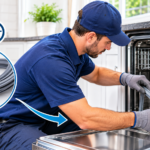


Check the gasket first. It’s the only free, two-minute test, and it causes a specific set of symptoms: the door won’t stay shut on its own, cold air leaking near the edges, and a rising energy bill with no other explanation. If those signs aren’t there, or the gasket checks out fine, the problem is more likely the compressor, thermostat, or control board, and those need a technician either way.
Key takeaways
- Check the gasket first. It’s free, takes two minutes, and rules out or confirms the single most common cause
- A failing gasket causes a specific pattern: the door won’t stay shut on its own, condensation or frost near the door edges, and a rising energy bill
- A failing compressor looks different. It runs constantly or won’t run at all, makes clicking or humming noises, and the back of the unit feels unusually hot
- A thermostat or control board problem often shows up as inconsistent temperatures or a fridge that won’t respond to setting changes at all
- If the gasket test comes back clean and the fridge is still warm, the problem is in a part that needs a trained technician, not a quick fix
- Appliance Gasket quotes one exact price after getting your appliance’s brand and model, with a $75–$95 diagnostic fee credited toward your repair, and offers same-day service across DC, Maryland, and Northern Virginia
- Call (202) 200-8501 for a model-based quote
Check the gasket first: the one free test before anything else
Before assuming a bigger problem, run the dollar bill test. Close a dollar bill in the door at several points around the frame and pull gently. If it slides out easily instead of resisting, the seal has lost its grip, and that’s the first thing worth ruling out, since it’s the only diagnostic step in this whole process that costs nothing and takes under two minutes.
This matters because the gasket sits at the bottom of nearly every other symptom on this list. A seal that’s lost its grip lets warm air leak in constantly, which forces the compressor to run longer and harder just to keep up, which can look a lot like a compressor problem even when the compressor itself is fine. Starting here saves you from chasing an expensive diagnosis when the actual fix might just be the seal itself, a far smaller cost than a compressor or control board repair. The full dollar bill test walkthrough covers how to check a French door or double door model, where there are two separate seals to test instead of one.
Signs it really is the gasket
A door that won’t stay shut on its own, condensation or frost building up near the door edges, and a rising energy bill with no other explanation all point to the gasket, since all three come from warm air leaking past a seal that’s lost its grip. These three signs tend to show up together rather than one at a time, which is part of what makes a gasket problem easy to confirm once you know what to look for.
A refrigerator door that drifts open instead of staying shut on its own has usually lost the magnetic pull the gasket is supposed to provide. Frost or condensation specifically near the door, rather than spread evenly through the freezer, points to the same leak. And an energy bill that climbs with no other change in household habits often means the compressor has been working overtime to compensate for exactly this kind of air leak. If you’re seeing two or more of these together, six signs you need a new gasket walks through what each one means in more detail.
This shows up for a specific, local reason too. Many DC rowhouses were built with tight galley kitchens where the refrigerator door repeatedly brushes against a cabinet or wall every time it opens, and that kind of daily contact wears out a seal faster than it would in a roomier kitchen layout.
Signs it’s the compressor, not the seal
A compressor problem looks different from a gasket problem. It shows up as the refrigerator running constantly without the temperature actually dropping, loud clicking or humming noises coming from the back of the unit, the back panel feeling unusually hot to the touch, or the compressor not running at all, no hum, no vibration, nothing.
This is the distinction that gets missed most often. A refrigerator that’s warm inside doesn’t automatically mean a bad seal, and a lot of people replace or clean a gasket first simply because it’s the part they can see and touch. But if the dollar bill test came back fine and you’re hearing new noises, or the unit is cycling on and off far more frequently than it used to, that points toward the compressor instead. A compressor that’s failing often runs hotter than normal at the back of the fridge, specifically because it’s working harder to make up for lost efficiency, which is a different mechanism entirely from a door seal letting air escape.
Signs it’s the thermostat or control board
A thermostat or control board problem tends to show up as inconsistent temperatures that don’t respond when you adjust the setting, or a fridge that cools fine in one section, like the freezer, while the other section stays warm. Unlike a gasket issue, this isn’t something you can test with a dollar bill, and unlike a compressor issue, it won’t always come with an obvious noise or heat signature.
The giveaway here is usually the mismatch between what you set and what actually happens. If you turn the dial colder and nothing changes after several hours, or if one compartment behaves normally while the other doesn’t, that’s a signal pointing at the control system rather than the seal or the compressor itself. This is also the category where opening anything up yourself isn’t a good idea, since diagnosing a control board safely means accessing the electrical panel, which is technician territory.
What to check before you call a technician
Run through four things before picking up the phone: the dollar bill test around the full door, confirming the fridge is actually plugged in and the breaker hasn’t tripped, checking that nothing inside is blocking the vents, and clearing off any visible frost buildup before assuming a part has failed. These four checks take about ten minutes combined and rule out the causes that don’t need a service call at all.
A surprising number of “my fridge stopped working” calls turn out to be a tripped breaker or a vent blocked by a tall container, not a failed part. Clearing frost matters too, since a heavy buildup can itself block airflow and mimic a cooling failure even when every part underneath is working correctly. While you’re working through these checks, keep an eye on the clock for food safety as well. FoodSafety.gov gives refrigerated perishables about 4 hours before meat, poultry, fish, eggs, and leftovers need to be treated as unsafe, so it’s worth moving anything perishable to a cooler with ice if the checks above are taking a while. If you’ve run through all four and the fridge is still warm, noisy, or behaving inconsistently, you’ve already done the useful part of the diagnosis yourself, and whatever a technician finds next will likely be one of the parts covered above.
When a gasket fix is enough, and when you need more than that
If the dollar bill test fails and the other signs point to the seal (the door drifting open, condensation at the edges, a climbing energy bill), replacing the gasket alone usually solves the problem completely. If the gasket test comes back clean and the fridge is still warm, noisy, or cycling oddly, the issue is almost always the compressor, thermostat, or control board, and no amount of gasket cleaning or maintenance will fix that.
This is really the whole decision in one sentence: the seal is the cheap, fast, DIY-checkable part, and everything else on this list is not. Treating the gasket as step one rather than guessing at the more expensive parts first is what actually saves money and time, whether the fix ends up being a new seal or a technician visit for something deeper.
The bottom line
The seal is the cheap, fast, DIY-checkable part, so it’s always worth ruling out first with a two-minute dollar bill test. If that test fails alongside the door drifting open, condensation at the edges, or a climbing energy bill, a gasket replacement usually solves it completely. If the gasket checks out fine and the fridge is still warm, noisy, or behaving inconsistently, the problem is in the compressor, thermostat, or control board, and that’s a technician job either way. Appliance Gasket quotes one exact price after getting your appliance’s brand and model, with a $75–$95 diagnostic fee credited toward your repair, and offers same-day service across DC, Maryland, and Northern Virginia.
Get your refrigerator diagnosed in DC, MD & VA
If the checklist above doesn’t give you a clear answer, the safest next step is a technician diagnosis rather than guessing further. Send your refrigerator’s brand, model, and ZIP code and Appliance Gasket will quote one exact price with a $75–$95 diagnostic fee credited toward your repair, with same-day appointments available across Washington DC, Maryland, and Northern Virginia. Reach out through our contact page to get started.
Appliance Gasket
Phone: (202) 200-8501
Email: Ilhamfraidoon@gmail.com
Address: Fairfax City, VA 22031
Serving Washington DC, Maryland & Northern Virginia
Frequently asked questions
Q1: Can a bad gasket make the compressor run constantly?
Yes. A seal that’s lost its grip lets warm air leak into the fridge continuously, and the compressor has to run longer and more often to compensate for that lost cold air. This is exactly why a gasket problem can look like a compressor problem at first glance, even though the compressor itself might be completely fine.
Q2: Is a refrigerator that’s cooling but not cold enough the same problem as one that’s not cooling at all?
Not necessarily. A fridge that’s cooling but running a few degrees warmer than it should often points to a gasket leak, dirty condenser coils, or a vent blocked inside the unit. A fridge that’s not cooling at all, with the compressor not even running, usually points to something more serious like a compressor or control board failure. The degree of the problem is a useful clue on its own.
Q3: Can cleaning the gasket fix a cooling problem without replacing it?
Sometimes, yes. A gasket covered in grime, old food residue, or sticky buildup can fail the dollar bill test simply because dirt is preventing a tight seal, not because the rubber itself has failed. Cleaning it with warm water and mild soap and retesting is worth doing before assuming you need a full replacement.
Q4: How fast should food be moved if the fridge stops cooling?
Perishable food should be moved to a cooler with ice or to a working fridge within about 4 hours of the refrigerator losing power or cooling, since that’s roughly the window before meat, poultry, fish, eggs, and leftovers need to be treated as unsafe to eat. If you’re not sure how long it’s been warm, it’s safer to treat perishables as compromised than to guess.
Q5: Is it worth repairing an older refrigerator, or should it be replaced instead?
It depends on what actually failed. A gasket replacement is worth doing on a refrigerator of almost any age, since the part itself is inexpensive relative to the cost of a new fridge. A major compressor or control board failure on a refrigerator that’s already 10 or more years old is a different calculation, since you’re weighing a significant repair bill against a unit that may have other parts nearing the end of their life too.
Q6: Can a warped or unlevel door cause the same symptoms as a bad gasket?
Yes. A refrigerator that isn’t sitting level, or a door that’s warped from age or an old repair, can create the exact same gap and air leak that a failed gasket causes, even if the rubber seal itself is in good condition. If a new gasket doesn’t fully solve a door-not-sealing problem, checking whether the unit is level is the next thing worth looking at.